
Summer walks with your dog should be fun — not a trip to the emergency vet. The truth is, how to protect dogs feet from hot pavement becomes critical because the ground under your dog’s paws gets dangerously hot long before the air temperature feels uncomfortable to you.
🌡️ Do Dogs’ Paws Actually Get Hot on Pavement?
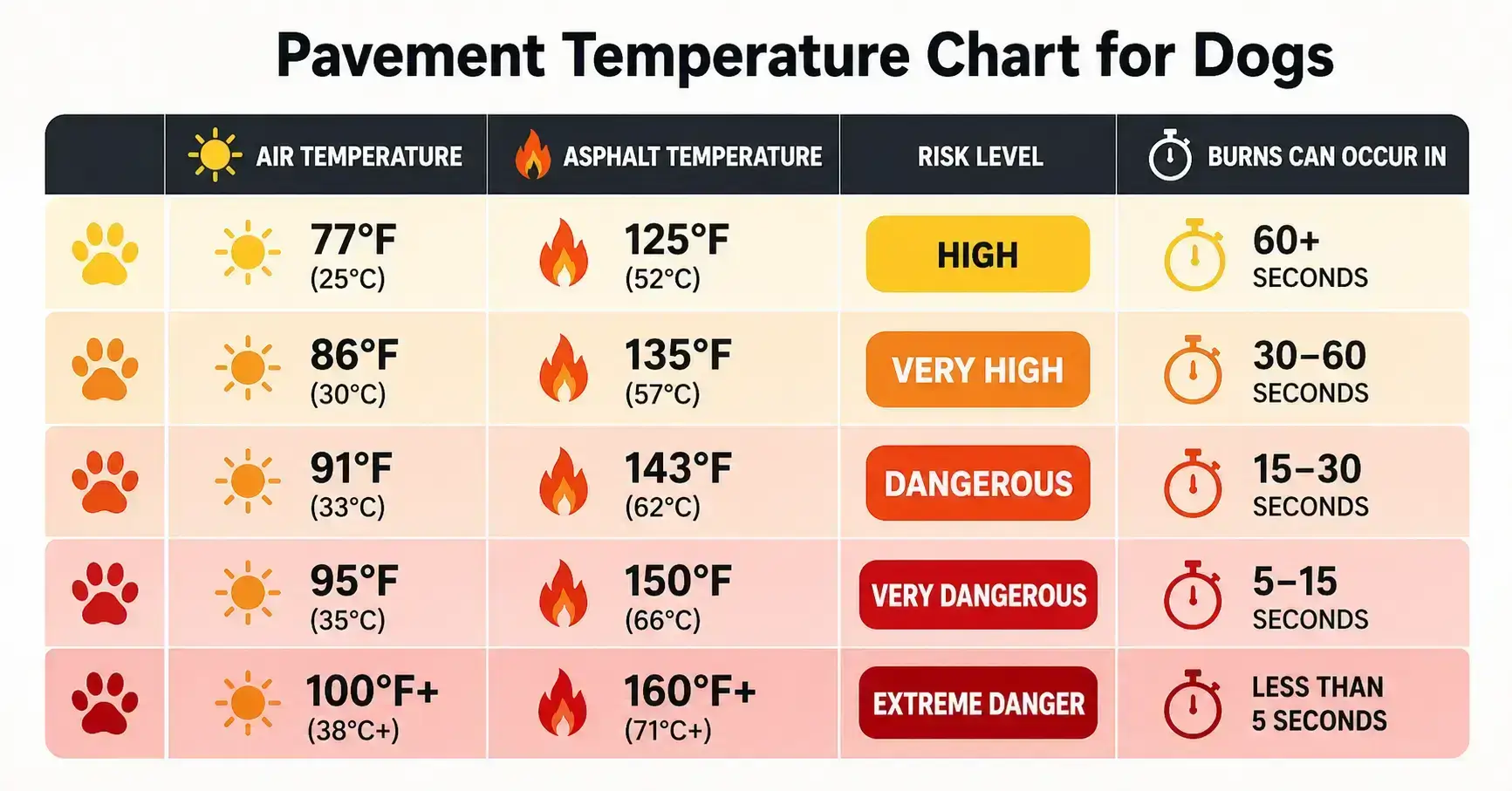
Yes — and faster than most owners realize. Your dog’s paw pads are made of thick, specialized skin, but they are not heatproof. They’re closer in sensitivity to the skin on your palm than to the sole of a shoe.
According to research published in the Journal of the American Medical Association on thermal contact burns, asphalt surfaces can reach 125°F when the air temperature is only 77°F, 135°F when the air is 86°F, and 143°F when the air hits 87°F. That’s a single degree of air difference causing an 8-degree spike on the ground. Frightening, right?
When a surface reaches 125°F, burnt paws can happen in just 60 seconds — and even faster when temperatures climb higher. That means asphalt is too hot for your dog on a standard 85°F day.
Dogs also sweat through their paws, so beyond burns, they use their pads to help regulate body temperature. In addition to damaged paws, In addition to damaged paws, hot pavement can increase a dog’s body temperature and contribute to heatstroke in dogs — a genuine medical emergency that every owner should understand.. This isn’t a minor inconvenience — it’s a genuine health risk.
🌞 Pavement Temperature Chart for Dogs: Air vs. Ground
Most people check the weather app before a walk. That’s a good start, but the air temperature and the ground temperature are two very different numbers — and your dog lives closer to the ground.
When the air is 77°F (25°C), asphalt in the sun can reach as high as 125°F (51°C). When the air is 86°F (30°C), asphalt can climb to 135°F (57°C). Veterinary experts confirm that burns can occur in as little as 60 seconds on pavement at 120°F (49°C), and in under a minute when temperatures exceed 140°F (60°C).
Pavement Temperature Chart for Dogs
| Air Temperature | Asphalt Temperature | Risk Level | Burns Can Occur In |
|---|---|---|---|
| 77°F (25°C) | 125°F (51°C) | High | ~60 seconds |
| 85°F (29°C) | 135°F (57°C) | Very High | Less than 60 seconds |
| 87°F (31°C) | 143°F (62°C) | Extreme | Seconds |
| 90°F (32°C) | 150°F (65°C) | Dangerous | Immediate |
| 95°F (35°C) | 155°F (68°C) | Extreme Danger | Immediate |
Sources: WSU College of Veterinary Medicine; JAMA thermal contact burn research; fonjonpetcare.com
It’s also worth knowing that not all surfaces heat equally. A study by Frostburg University found that when concrete reaches 104°F, brick can get as hot as 109°F and asphalt as hot as 124°F under similar conditions. Sand, brick, and even artificial turf can also reach dangerous temperatures quickly — it’s not just asphalt you need to worry about.
🤚 The Seven-Second Rule: The Easiest Test You’ll Ever Do
Before every summer walk, do this one quick check. It costs zero dollars and takes seven seconds.
Place the back of your hand on the pavement and hold it there for seven seconds. If you cannot hold it there for the full seven seconds, the surface is too hot for your dog’s paws.
Some vets extend this to ten seconds for extra caution. According to Dr. Klein of the American Kennel Club, placing your hand comfortably on the pavement for ten seconds is a reliable guide — if it’s too hot for your hand, it’s too hot for your dog’s paws. Your bare foot works just as well, and this test applies to any surface: concrete, sand, metal grating, and dirt.
This simple habit takes about as long as unlocking your front door, and it could save your dog from a painful injury.
⏰ What Time Is Safe to Walk Your Dog on Pavement?
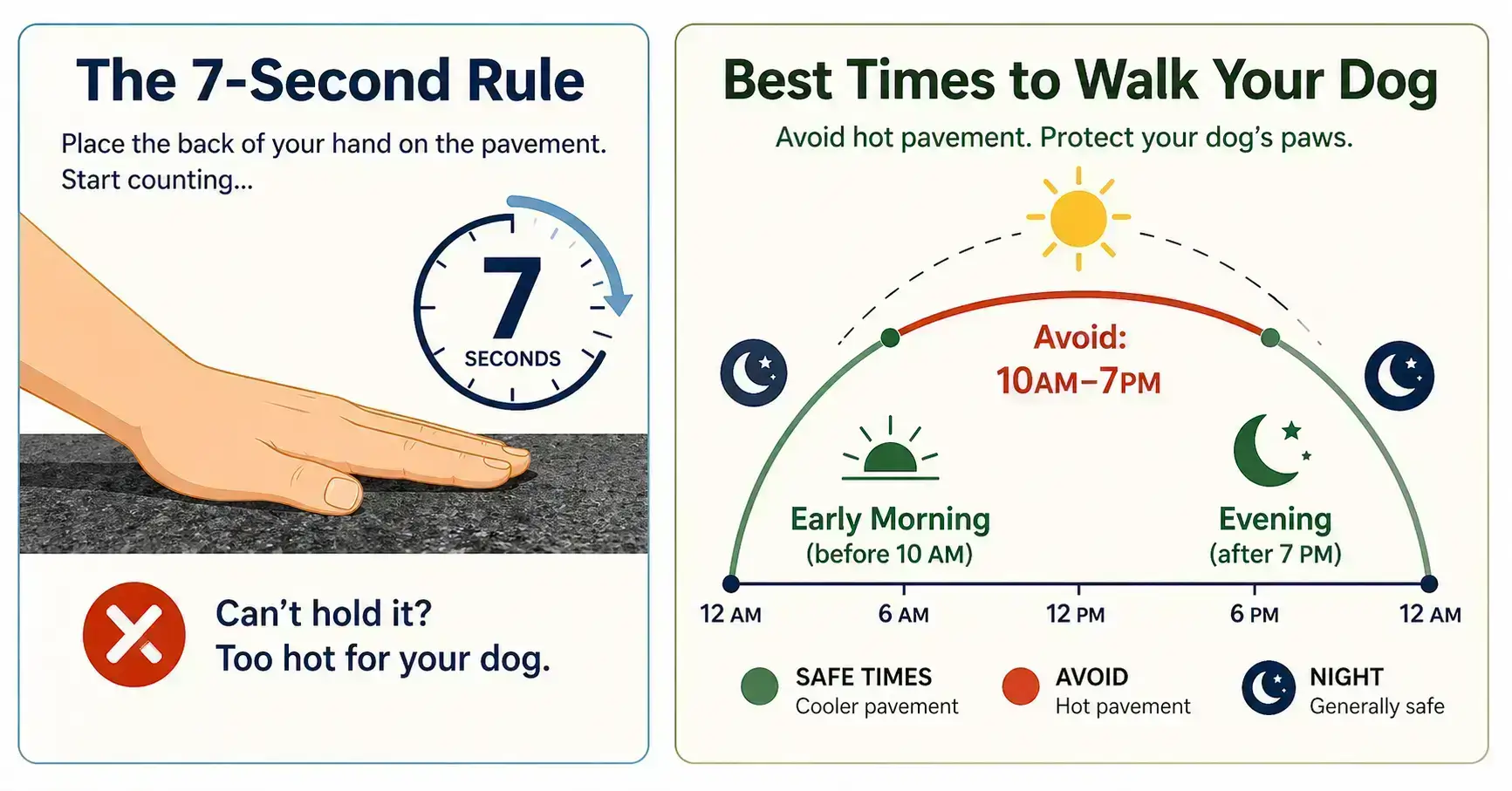
Timing matters more than most people think. Pavement absorbs heat throughout the day and holds it long after the sun goes down.
Try to walk your dog early in the morning before 10 a.m. or later at night after 7 p.m., when the pavement is likely to be cooler. Avoid the afternoon and early evening, when accumulated heat makes the ground most dangerous.
Here’s an important note: even cloudy days don’t offer a free pass. Asphalt and concrete absorb heat and hold it for hours, meaning the ground can still be dangerously hot on cloudy afternoons or warm summer evenings. Always do the hand test regardless of cloud cover. The American Kennel Club offers detailed seasonal guidance on this — their summer paw protection advice is a reliable reference worth bookmarking.
🐾 How to Walk Dogs on Hot Pavement (When You Have No Choice)
Sometimes you’re stuck — you’re traveling, it’s a quick bathroom break, or your neighborhood simply doesn’t have grass. Here’s how to manage those situations safely.
Stick to shaded routes
Pavement in the shade stays significantly cooler than pavement in direct sunlight. Plan routes that pass through tree-lined streets, covered parking areas, or buildings that cast shade across the sidewalk.
Keep it short
A quick bathroom break is very different from a 45-minute exercise session. During summertime when temperatures spike, it is very important to only exercise your dog during cooler parts of the day and for shorter periods. Dogs do not have many sweat glands and do not cool nearly as efficiently as humans.
Choose grass when available
Grass surfaces stay much cooler than any paved surface. Even running alongside a road on the grass verge instead of the sidewalk makes a meaningful difference.
Bring water
Heat stress can develop quickly on hot days, especially for flat-faced breeds like pugs and bulldogs, or dogs already managing conditions like a heart murmur — always carry water and offer it frequently.
🥾 Dog Booties for Hot Pavement: Do They Actually Work?
Dog booties offer the most direct physical barrier between your dog’s paws and a scorching surface. If your dog will tolerate them, they’re one of the most effective tools you have.
Dog shoes with rubber or neoprene soles are most protective against damaging surfaces. However, they should not be worn for extended periods, since the sweat glands in your dog’s paws allow body temperature regulation — something that can be restricted inside a boot.
The biggest challenge with booties is getting your dog to accept them. To help your dog get used to booties, let them wear them for short periods indoors first and reward them with praise or a small treat — try these easy homemade dog treats for a vet-approved reward they’ll actually love.
When buying boots, fit matters enormously. Getting the right size — fitting snugly but not too tight and not too loose — helps your dog acclimate to wearing shoes. Choose foot coverings with wrap-around closures and full-foot grips on the bottoms.
Comparison Table: Dog Booties
| Boot Type | Best For | Heat Protection | Breathability | Price Range |
|---|---|---|---|---|
| Rubber/neoprene soled boots | Hot pavement and rough terrain | Excellent | Moderate | $20–$60 |
| Mesh summer boots | Warm weather walks | Good | High | $15–$40 |
| Disposable rubber boots | Short trips, casual use | Moderate | Low | $15–$25 |
| Reflective foil boots | Extreme heat surfaces | Very Good | Moderate | $25–$55 |
🕯️ Paw Wax and Paw Balm for Dogs: What Does It Actually Do?
Paw wax creates a semi-protective barrier on your dog’s pads. It won’t replace booties on a 140°F surface, but it adds a layer of defense and keeps pads from drying out and cracking — which makes them more vulnerable to burns.
The most well-known product in this category is Musher’s Secret. Jessica Apted, DVM, Regional Medical Director for Sploot Veterinary Care, describes it as “a long-time veterinary favorite,” praising it for being breathable, protective, and effective for both winter salt and hot pavement.
Musher’s Secret is made from a blend of food-grade, ethically sourced waxes and oils with Vitamin E. It forms a semi-permeable shield absorbed into the paws, allowing perspiration to escape through the pads. This breathability is important — you don’t want your dog’s paws sealed off entirely in the heat.
For hot pavement specifically, boots that completely block heat transfer offer more protection than waxes, which merely reduce it. Wax is most effective as a conditioning and supplementary tool rather than a standalone solution for extreme heat.
How to apply paw wax at home:
- Apply a thin layer to each pad and between the toes.
- Rub it in gently — it softens with body heat.
- Allow 2–5 minutes for partial absorption before heading out.
- Re-apply every 2–3 hours on longer outings.
🏠 How to Protect Dogs’ Feet from Hot Pavement at Home (DIY Options)
Not everyone can run to a pet store immediately. Here are some practical at-home approaches that actually work.
Petroleum jelly (Vaseline)
A thin layer of plain Vaseline provides a temporary moisture barrier. It can be used occasionally for brief protection, but lacks the staying power and healing ingredients found in pet-specific products. Think of it as a short-term solution for a quick trip outside.
Baby socks with grip pads
Not ideal, but in an emergency they provide a small buffer. The key is making sure they actually stay on — rubber-grip baby socks hold better than plain cotton.
Conditioning the paws
Walking on pavement during cool weather helps toughen your dog’s pads and builds resistance for when temperatures heat up. Gradually exposing paws to different textures helps build resilience over time — and many owners overlook this completely free approach.
Keeping pads moisturized
Dry, cracked pads burn more easily. Regular moisturizing is good preventive care year-round, because when pads are dry they’re more susceptible to damage from any hot surface.
🏖️ How to Protect Dogs’ Feet from Hot Sand
Beach days come with their own set of hazards. Sand, especially light-colored dry sand, can reach temperatures similar to asphalt in direct sun — and it’s sneaky because it looks harmless.
The same principles apply: do the hand test before letting your dog walk freely, walk during early morning or late evening, and stick to the wet sand near the water’s edge where temperatures are dramatically lower. Booties work on sand too, though many dogs dislike the sensation in loose terrain. Paw wax is often more practical for sandy environments.
Sand, brick, and even artificial turf can heat up almost as quickly as asphalt, making them uncomfortable and sometimes painful for sensitive paws. Never assume a non-pavement surface is automatically safe just because it’s not asphalt.
🚨 Signs Your Dog’s Paws Are Burned — And What to Do
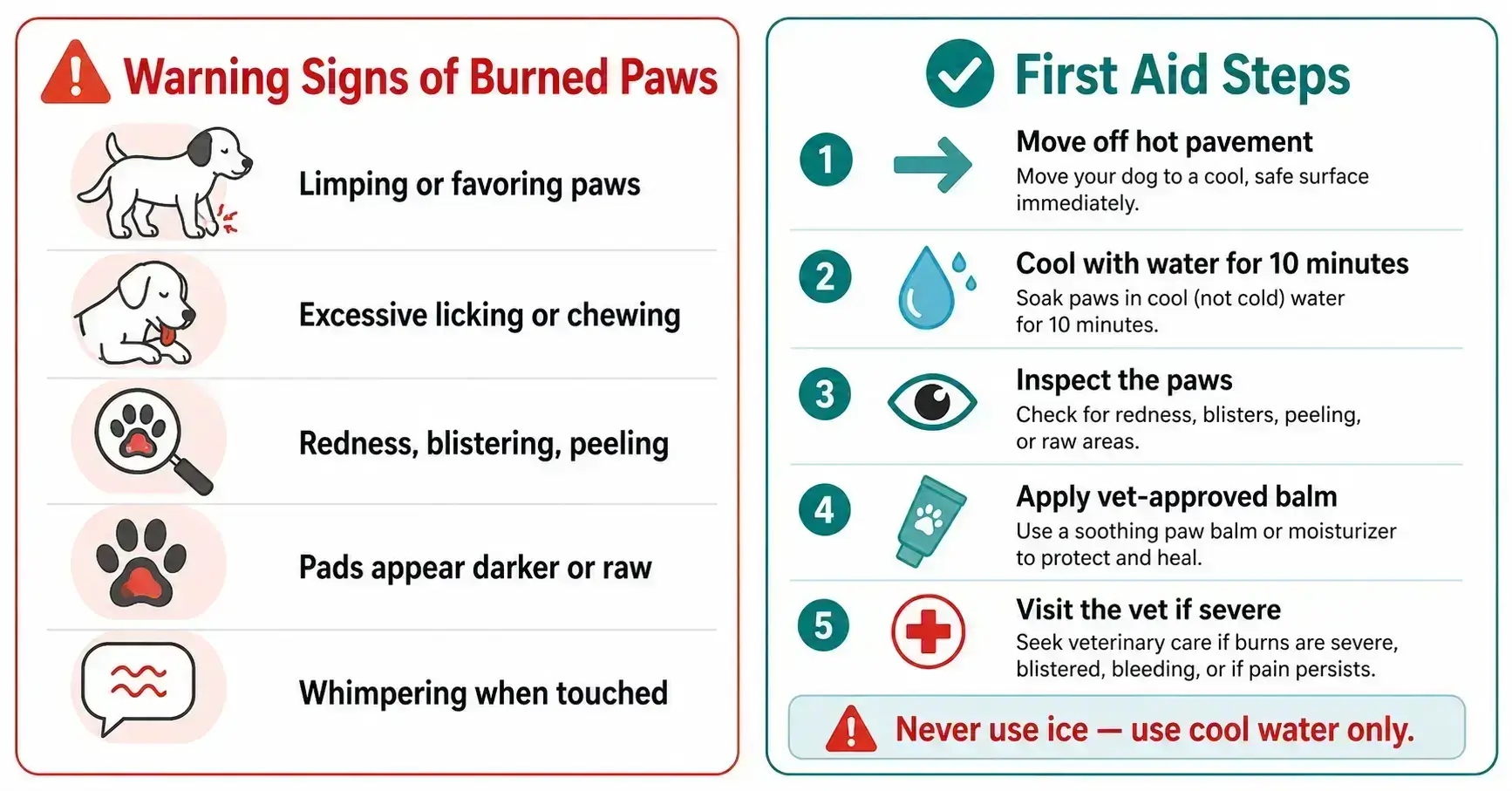
Dogs don’t always show obvious distress right away. By the time your dog is crying or refusing to walk, significant damage may have already occurred. Watch for these early warning signs:
Signs to watch for:
- Limping or favoring certain paws
- Licking or chewing at the feet persistently
- Redness, blistering, or peeling of the pads
- Pads that appear darker than normal or have a raw look
- Whimpering when you touch the feet
“Keep in mind that limping doesn’t always mean a paw burn — it could also signal a joint issue. Learning the signs of luxating patella in dogs can help you tell the difference before rushing to conclusions.”
First aid if burns occur:
Move your dog off the hot pavement immediately onto a cool, shaded area. Place the paws in cool — not ice-cold — water for at least 10 minutes to reduce heat and soothe the burn. Inspect for blisters, redness, or peeling. If burns are severe, take your dog to the vet immediately. Apply a vet-approved paw balm or ointment to keep the pads moist and support healing.
Never apply ice directly to burned paws — it can restrict blood flow and worsen tissue damage. Cool water is always the right call.
🐕 Do Dogs Need Shoes for Hot Pavement?
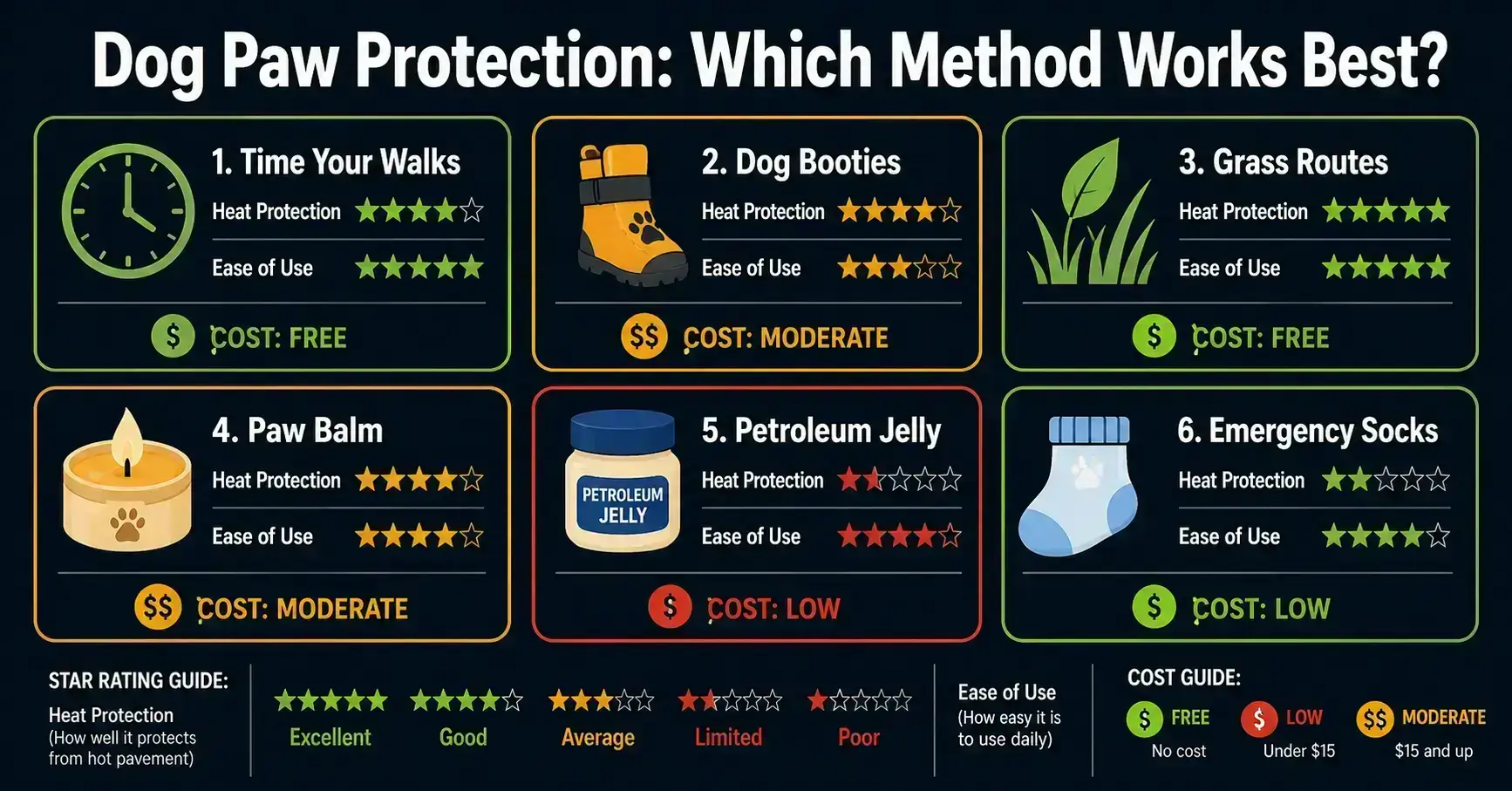
The answer depends on conditions, not opinion. For a quick bathroom break at 8 a.m. on a cool morning, probably not. For a midday walk on a sun-baked sidewalk in August, absolutely yes.
Asphalt can reach 130°F when outdoor air temperature reaches 85°F. A dog’s feet simply cannot handle such high temperatures, and owners may need to seek veterinary attention immediately after a pet’s paws touch hot asphalt.
Shoes are the most reliable protective option when surfaces are dangerously hot. But they work best when your dog has been introduced to them gradually, and they shouldn’t be worn for extended periods in heat because they can restrict the natural cooling function of the paw pads.
The honest takeaway: the best shoe is the one your dog will actually wear, combined with smart timing and smart route choices.
📊 Paw Protection Methods: A Side-by-Side Comparison
Paw Protection Methods
| Method | Ease of Use | Heat Protection | Cost | Best For |
|---|---|---|---|---|
| Walking at cooler times | Very Easy | Complete avoidance | Free | Every dog owner |
| Grass and shade routes | Easy | High | Free | Neighborhood walks |
| Seven-second test | Very Easy | Prevention tool | Free | Daily habit |
| Dog boots and booties | Moderate | Excellent | $15–$60 | High-heat conditions |
| Paw wax (Musher’s Secret) | Easy | Moderate | $10–$25 | Supplement to timing |
| Petroleum jelly (DIY) | Easy | Low to Moderate | $3–$8 | Emergency and short trips |
| Baby socks (emergency) | Easy | Low | $5–$10 | Very short outings only |
❓ Short FAQs
What temperature is too hot to walk dogs on pavement?
If the air temperature is 77°F or above and the sun is out, the pavement is likely already at or above 125°F — hot enough to burn paws in under a minute. Use the seven-second hand test to confirm before every walk.
Can dogs’ paws burn on hot pavement?
Yes, absolutely. Paw pad burns are a real veterinary concern, and they can happen in as little as 60 seconds on very hot surfaces. First-degree burns cause redness and pain; second-degree burns cause blistering and require vet care.
Does paw wax protect dogs from hot pavement?
It provides a supplementary barrier and keeps pads conditioned, but it cannot fully replace physical barriers like boots when surfaces are extremely hot. Think of it as sunscreen — helpful, but not a substitute for staying out of dangerous conditions.
Should dogs wear shoes in summer?
For hot surfaces, yes — if your dog tolerates them. Introduce them gradually with positive reinforcement. For cooler morning or evening walks on moderate ground, shoes aren’t usually necessary.
How do I know if the pavement is too hot for my dog right now?
Do the seven-second hand test: press the back of your hand to the pavement. If you can’t hold it there comfortably for seven full seconds, it’s too hot. No thermometer needed.
What can I use at home to protect my dog’s paws from hot pavement?
A thin layer of petroleum jelly offers short-term protection for quick outings. For more reliable and longer-lasting protection, purpose-made paw wax like Musher’s Secret is widely available and vet-recommended.
Is hot pavement dangerous for puppies specifically?
Yes, even more so. Young puppies have softer, more sensitive paw pads that haven’t yet toughened through regular walking. They’re at higher risk of burns than adult dogs with more conditioned pads.




One Response