

You leave a sock on the floor for two minutes. You come back and your dog is halfway through it like it’s a gourmet meal. Sound familiar? You’re not alone — and no, your dog isn’t broken. There are real, well-documented reasons this happens, some behavioral, some medical, and all worth understanding.
🐶 Why Does My Dog Eat Socks in the First Place?
The short answer: your socks smell exactly like you, and that makes them irresistible to dogs. The longer answer involves instinct, boredom, anxiety, and sometimes a medical condition called pica. Dogs explore the world through their mouths, and a sock that carries your scent is basically a comfort object wrapped in temptation.
According to PetMD, items like underwear, socks, pantyhose, and wet wipes are particular favorites among dogs — specifically because they can detect their pet parents’ scent on them. This isn’t random. Your dog literally seeks out your smell when they miss you or feel anxious.
That said, if sock-eating is happening regularly and compulsively, it can point to something deeper. Understanding the difference between normal dog curiosity and a real problem is the first step.
🧠 What Is Pica in Dogs, and Could Your Dog Have It?
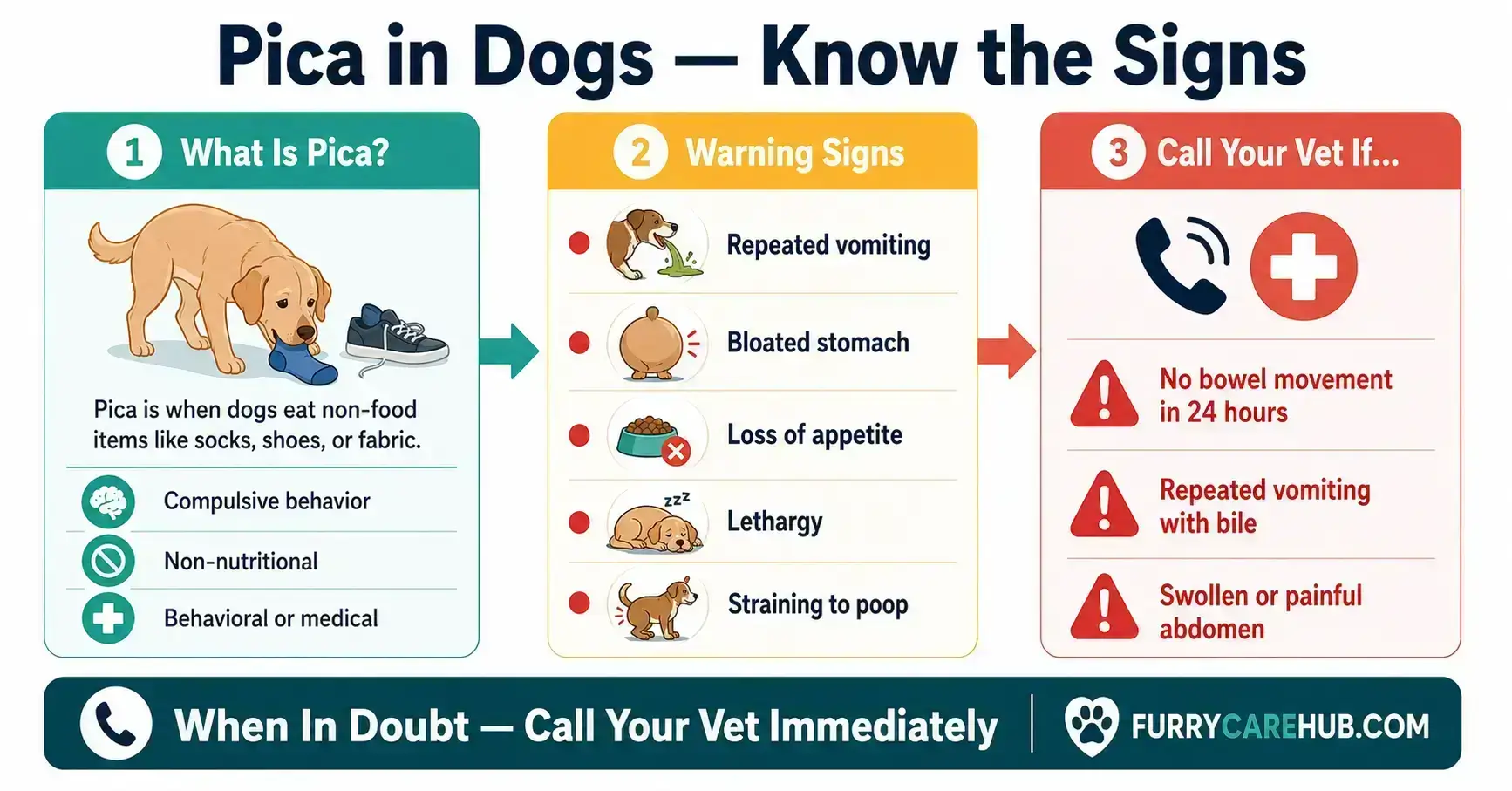
Pica is a condition where dogs persistently eat non-food items — recognized medically as pica as a recognized disorder that affects both humans and animals and is classified by its compulsive, non-nutritional nature, not just chewing them, but actually swallowing them. It’s consistently eating substances that provide zero nutrition or physical benefit to the dog, whether that’s socks, rocks, plastic, paper, or dirt.
A 2024 Rover survey of 1,000 dog parents revealed that a significant 73% of dogs exhibit pica behavior at some point. The most commonly consumed items were paper (43%), toilet roll (36%), their own dog toys (32%), and plants (27%). Despite how common it is, nearly half of all pet parents (48%) remain unaware of the potentially dangerous outcomes.
Pica is typically considered a psychological, obsessive-compulsive habit, but it can also result from a medical condition or poor nutrition. So while your sock-obsessed dog might just be bored, they could also be telling you something important about their health.
🔍 What Causes a Dog to Eat Socks and Other Non-Food Items?
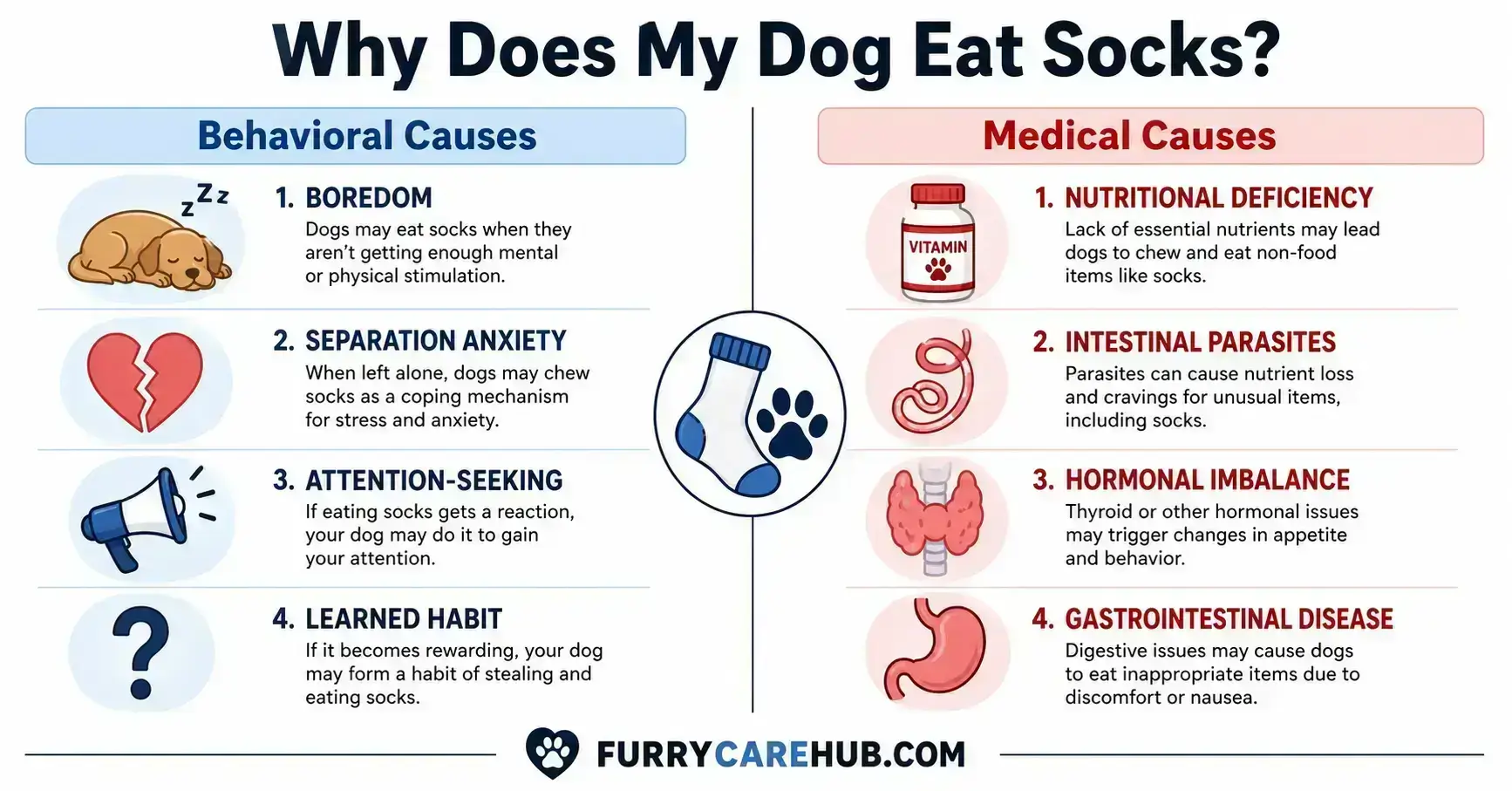
There’s no single cause — and that’s what makes this tricky. Both behavioral and medical triggers exist, and sometimes it’s a combination of both.
On the behavioral side, the most common culprits are boredom, lack of mental stimulation, stress, separation anxiety, and even attention-seeking. When a dog learns that eating a sock gets a dramatic reaction from their owner, some will do it on repeat. Dogs are smart like that — sometimes frustratingly so.
On the medical side, nutrient deficiencies, intestinal parasites, diabetes, thyroid imbalances, or inflammatory bowel disease may cause dogs to eat unusual objects in an attempt to fill in the gaps or soothe discomfort. A study cited in the AKC even documented a Labrador Retriever who compulsively ate stones until they received treatment for hip pain — once the pain was managed, the behavior stopped entirely.
| Cause | Type | What It Looks Like |
|---|---|---|
| Boredom or under-stimulation | Behavioral | Happens most when dog is alone or inactive |
| Separation anxiety | Behavioral | Worsens when owner leaves; may accompany destructive behavior |
| Attention-seeking | Behavioral | Dog grabs socks and waits for a reaction |
| Nutritional deficiency | Medical | Dog may also eat dirt, grass, or unusual foods |
| Intestinal parasites | Medical | Often accompanied by weight loss or digestive issues |
| Thyroid or metabolic issues | Medical | Vet bloodwork required to confirm |
| Inflammatory bowel disease | Medical | Accompanied by vomiting, diarrhea, weight loss |
| Pain (undiagnosed) | Medical | Pica disappears once underlying pain is treated |
Sporting and retriever breeds, such as Labrador Retrievers and Golden Retrievers, may be more prone to pica because they have such a strong instinct to carry things in their mouths. That instinct doesn’t always stop at just carrying.
🧦 Why Does My Dog Eat Socks and Then Throw Them Up?
This happens because a dog’s stomach often rejects the foreign material it cannot digest. Vomiting after eating a sock is actually the body’s defense mechanism trying to expel something that doesn’t belong there.
If your dog regularly eats socks and then vomits them back up, do not take that as a sign that everything is fine. Repeated ingestion followed by vomiting can indicate a compulsive behavior pattern that needs professional evaluation. It also means the sock is making it back out — but that won’t always be the case.
The real danger is when a sock doesn’t come back up and instead travels further into the digestive system. Vomiting after swallowing non-food items is your dog’s body sending a clear distress signal — similar to how grass-eating and vomiting works as a gut-clearing mechanism. If your dog does this frequently, our article on why dogs eat grass and throw up gives useful context on how a dog’s digestive system responds to things it wasn’t designed to handle
⚠️ What Happens If a Dog Swallows a Sock? The Blockage Risk
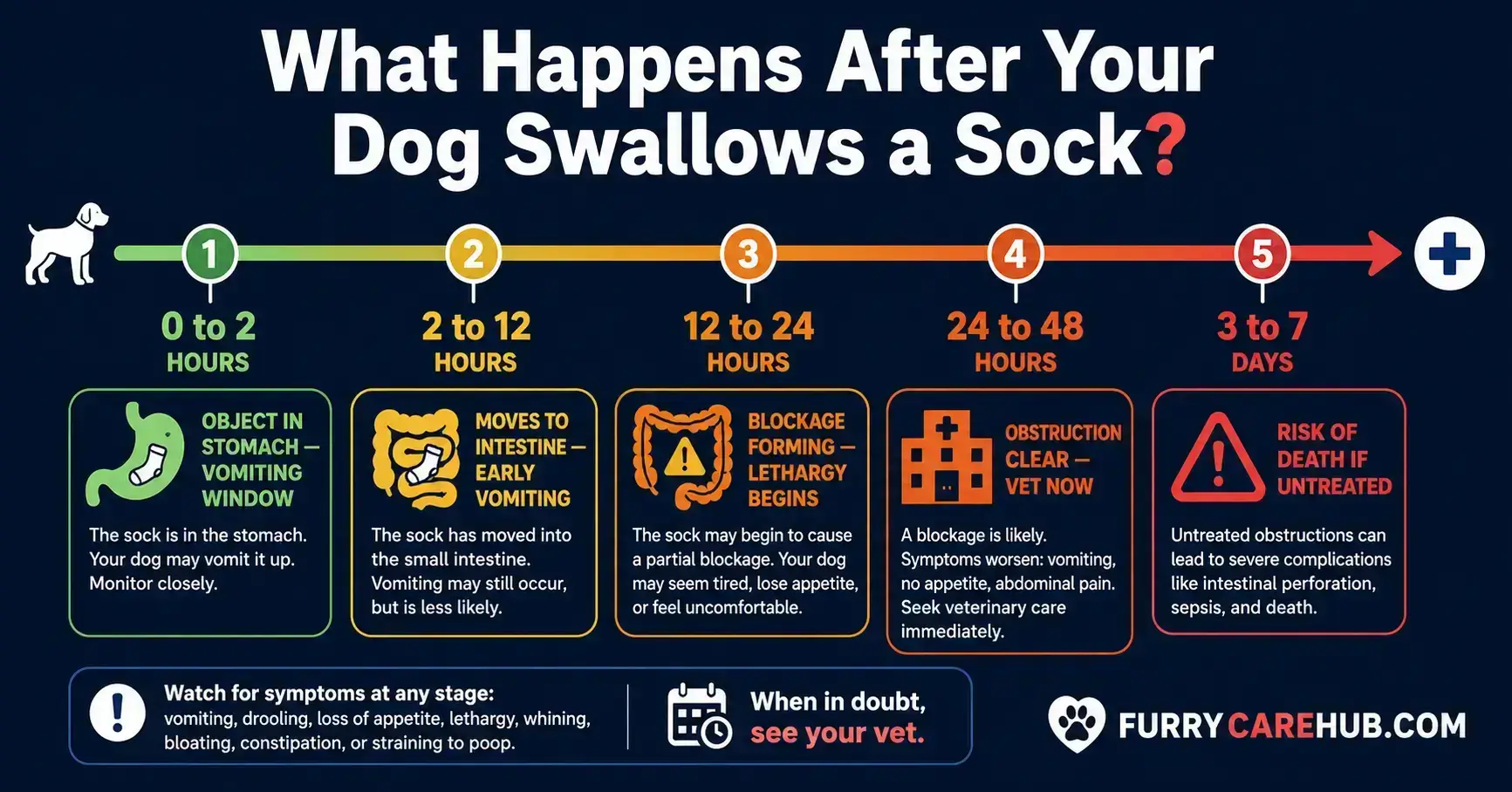
This is where things get serious. A swallowed sock can cause a partial or complete intestinal obstruction — a genuine medical emergency that cuts off the normal movement of food, fluid, and blood supply through the digestive tract.
Soft items like socks can ball up and become compacted deep in the intestines, blocking everything behind them. A dog can die from an intestinal blockage within 3 to 7 days if left untreated. That is not a long window, and symptoms can be easy to misread in the early stages.
The most common early symptoms of a blockage include vomiting (especially repeated episodes), loss of appetite, lethargy, and straining to pass stool. As the blockage worsens, symptoms escalate to a swollen or painful abdomen, bile-tinged vomit, extreme low energy, hunching, and crying when touched.
| Time After Ingestion | What May Be Happening |
|---|---|
| 0–2 hours | Object in stomach; best window for vet-induced vomiting if appropriate |
| 2–12 hours | Object may move into small intestine; early vomiting can begin |
| 12–24 hours | Partial or full blockage developing; increased vomiting and lethargy |
| 24–48 hours | Clear signs of obstruction; immediate vet care essential |
| 3–5 days | Risk of intestinal rupture, sepsis, and organ failure |
| 3–7 days | Can be fatal without surgical intervention |
According to Pet MD, veterinary-induced vomiting should only be done within the first 30 minutes to two hours after ingestion. Never try to induce vomiting at home without speaking to a vet first — with soft objects like socks, it can sometimes cause additional complications.
If a foreign object does not pass within 36 hours, or stays in the same location for more than 8 hours based on imaging, surgery is typically required. Intestinal blockage surgery can cost anywhere from $500 to several thousand dollars, depending on the severity and whether it’s performed as an emergency procedure.
One sobering footnote from the AKC: a single dog once had 43 pairs of socks surgically removed. That’s not a typo.
😐 My Dog Ate a Sock But Is Acting Normal — Should I Worry?
Yes, even if your dog seems completely fine right now. Acting normal in the first few hours after eating a sock doesn’t mean the sock passed safely — it may simply mean it hasn’t caused a blockage yet.
Small dogs rarely pass socks safely, while larger dogs might occasionally pass a small sock without intervention. But there’s no reliable way to know at home which situation you’re dealing with. The size of the sock, the size of the dog, and where the sock is in the digestive tract all matter.
Contact your veterinarian even if your dog appears fine. Describe what was eaten, the approximate size of the item, and when it happened. Your vet can advise whether monitoring at home is reasonable or whether your dog needs to be seen immediately.
Do not play a waiting game if your dog shows any vomiting, changes in stool, appetite loss, or unusual behavior — even mild symptoms warrant a call.
🕐 My Dog Ate a Sock a Week Ago — What Now?
If it’s been several days and your dog has shown no symptoms whatsoever, it’s possible the sock passed through the stool without you noticing. Larger dogs can sometimes pass smaller socks that way.
However, if it’s been a week and you haven’t confirmed the sock passed — either by seeing it or by noticing your dog had an unusually large or unusual-looking bowel movement — a vet visit is warranted. Your vet can use X-rays or ultrasound to check whether anything remains in the digestive tract.
Soft items like socks don’t always show clearly on X-rays, so ultrasound is often the better diagnostic tool. A contrast study using barium may also be used to track movement through the digestive tract.
The key rule: when in doubt, call your vet. There’s no downside to getting it checked.
🐕 Why Is My Dog Suddenly Eating Socks All of a Sudden?
If this behavior is new, that’s actually important information. Sudden-onset pica-like behavior in a dog that didn’t show it before is more likely to have a medical cause than a behavioral one.
Sudden pica can signal emerging health issues like anemia, thyroid problems, or gastrointestinal disease that needs attention. Any new compulsive behavior in a dog, especially one that appears suddenly without an obvious trigger like a big lifestyle change, deserves a vet evaluation.
If you’ve recently moved, changed schedules, introduced a new pet, or reduced exercise and play time, behavioral triggers are also worth exploring. Dogs are creatures of routine, and disruptions can trigger anxiety-based behaviors including object ingestion.
🛑 How to Stop Your Dog from Eating Socks
The good news is that most causes of sock-eating can be addressed with the right approach. The strategy depends on whether the cause is behavioral or medical.
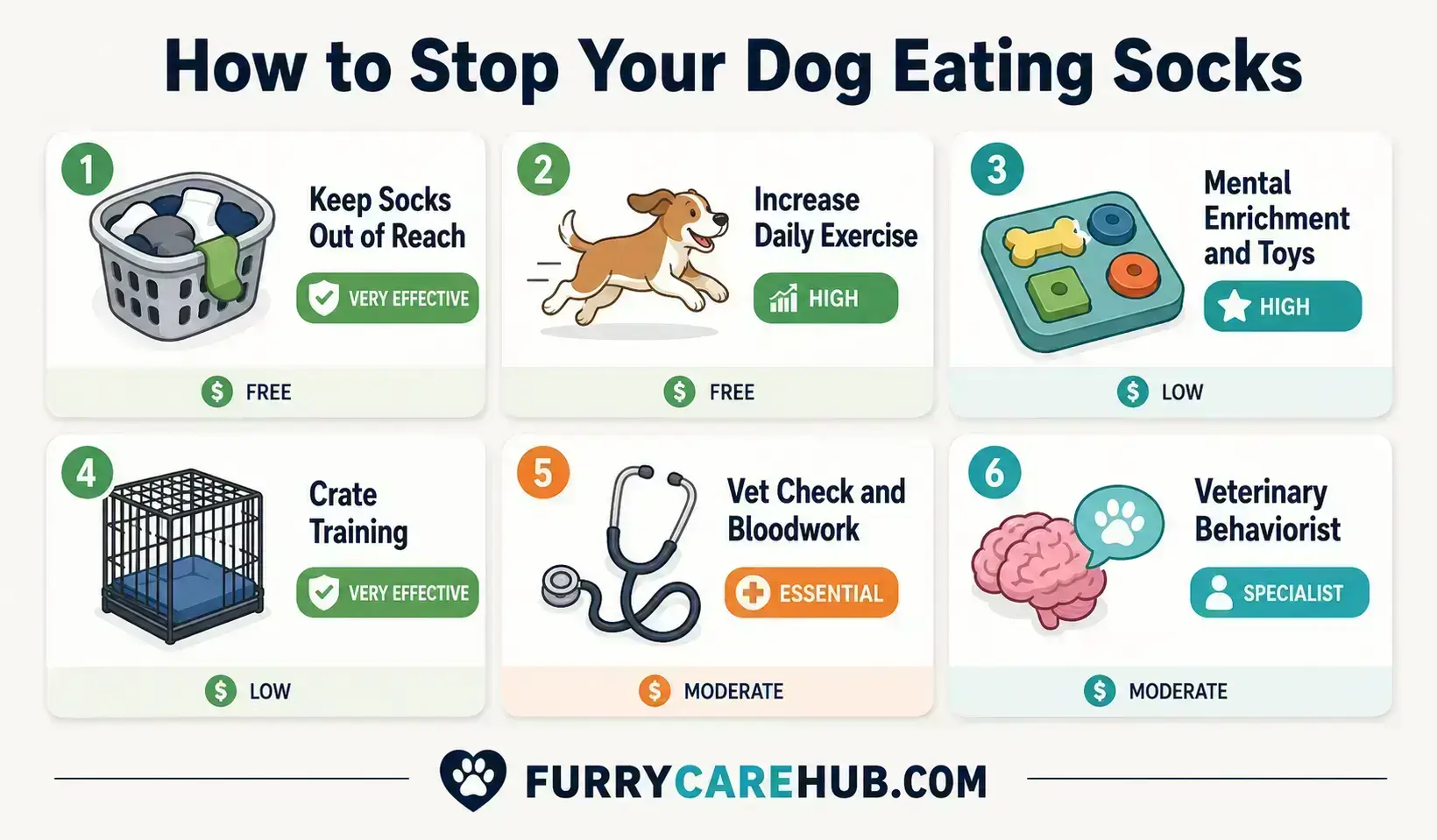
For behavioral causes, the primary tools are enrichment, exercise, and management. Increasing daily exercise, providing puzzle feeders and safe chew toys, and ensuring your dog isn’t spending long hours alone are all effective starting points. One of the most effective ways to redirect a sock-obsessed dog is to give them something genuinely worth chewing — our collection of easy homemade dog treat recipes includes vet-approved options that keep dogs occupied and satisfied without any of the risks that come with chewing non-food items.
Do not give your dog attention when they grab a sock — even negative attention can reinforce the behavior. Dogs that learn sock-stealing gets a big reaction from their owner will do it again.
For management at home, the simplest solution is also the most effective: keep laundry off the floor. Put dirty socks directly into a hamper with a lid, keep clean laundry folded and stored, and remove access to the items that your dog targets.
If the behavior persists despite enrichment and management, or if your vet suspects a medical cause, a board-certified veterinary behaviorist may be recommended. Behavior modification techniques, and in some cases medication to address underlying anxiety, can be part of long-term management.
| Approach | Best For | Effectiveness | Cost |
|---|---|---|---|
| Keep socks out of reach | All dogs | Very High | Free |
| Increase daily exercise | Bored or under-stimulated dogs | High | Low |
| Puzzle toys and enrichment | Mental boredom and anxiety | High | Low–Moderate |
| Crate training | Unsupervised dogs | Very High | Low |
| Vet check and bloodwork | Sudden or unexplained onset | Essential | Moderate |
| Veterinary behaviorist | Compulsive or persistent cases | High | Moderate–High |
| Anxiety medications | Anxiety-driven pica | Moderate–High | Moderate |
🐾 Puppy Eating Socks: Is It the Same Thing?
Not always. Puppies explore everything with their mouths — it’s how they learn about the world. A puppy that chews on or occasionally swallows a sock may simply be doing what puppies do, not displaying true pica.
As noted by Dr. Lainie Kringen-Scholtz, DVM, if a puppy is eating socks it is often just a phase that is mitigated by removing the opportunity and they will grow out of it. The key is management: keep socks inaccessible, provide appropriate chew toys, and redirect the behavior consistently.
If the behavior continues into adulthood or becomes compulsive, that’s when closer attention is needed. Puppy pica is real, but it often looks different from the persistent, driven sock-eating seen in adult dogs with a true behavioral or medical condition.
❓ Short FAQs
Why does my dog eat socks and underwear?
Both items carry your scent strongly, making them attractive to dogs seeking comfort or stimulation. They’re also soft, easy to chew, and small enough to swallow — which makes them a common target for dogs that chew or swallow non-food items.
Can a dog pass a sock naturally?
Larger dogs can sometimes pass a small sock on their own, but it’s not something you can reliably count on. Never wait to see if it passes on its own without first speaking to your vet. The risk of a blockage is too serious to gamble on.
How long does it take a dog to pass a sock?
Normal digestion in dogs takes 10 to 24 hours. A foreign object like a sock takes considerably longer and may not pass at all. If a sock doesn’t move or pass within 36 hours, veterinary intervention is typically required.
What is pica in dogs?
Pica is a condition where dogs compulsively eat non-food items. It can be behavioral in origin — linked to boredom, anxiety, or attention-seeking — or medical, stemming from nutritional deficiencies, parasites, hormonal disorders, or pain.
Is pica in dogs treatable?
Yes, though treatment depends on the cause. Medically caused pica often resolves when the underlying condition is treated. Behavioral pica is manageable with enrichment, training, and in some cases veterinary behaviorist support or anxiety medication. It can be a lifelong condition that requires ongoing management in some dogs.
Should I go to the vet if my dog ate a sock?
Yes, you should at minimum call your vet to discuss the situation. If your dog shows vomiting, lethargy, loss of appetite, or any abdominal pain, go in immediately. Even a dog acting normally after eating a sock should be monitored closely and cleared by a vet.
Why does my dog only eat my socks and not anyone else’s?
Because your socks carry your specific scent most strongly. Dogs have an extraordinarily powerful sense of smell, and they often target items belonging to the person they’re most bonded to — especially when experiencing separation anxiety or seeking comfort.




One Response