
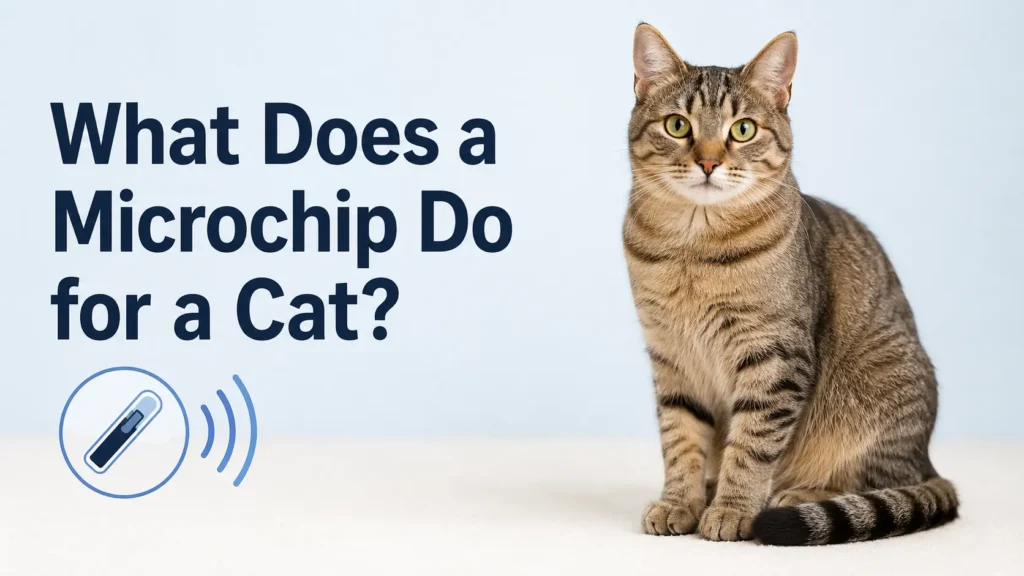
IntroductionA microchip gives a cat a permanent, scannable form of identification that helps reunite lost cats with their owners. Unlike a collar or tag, a microchip cannot fall off or become unreadable over time, which is why veterinarians widely recommend it for both indoor and outdoor cats as part of routine preventive care.
“Microchipping is one of the foundational preventive steps covered in our broader cat care guide, which outlines essential care practices for cats at every life stage.”
Quick Summary
- A microchip is a rice-grain-sized device implanted under a cat’s skin that stores a unique ID number linked to owner contact details in a registry.
- It is not a GPS tracker — it only works when scanned by a vet clinic, shelter, or animal control.
- Implantation is quick, requires no anesthesia, and causes only brief, mild discomfort similar to a routine injection.
- Microchips significantly improve the odds of a lost cat being identified and returned home.
- The chip only works if the linked registry information is kept current.
What Does a Microchip Do for a Cat?
A microchip gives a cat permanent, tamper-proof identification that survives the loss of a collar or tag. If a lost cat is brought to a shelter or veterinary clinic, staff scan the animal for a chip, retrieve the stored ID number, and cross-reference it against a pet recovery database to contact the owner.
How Scanning and the ID Database Work
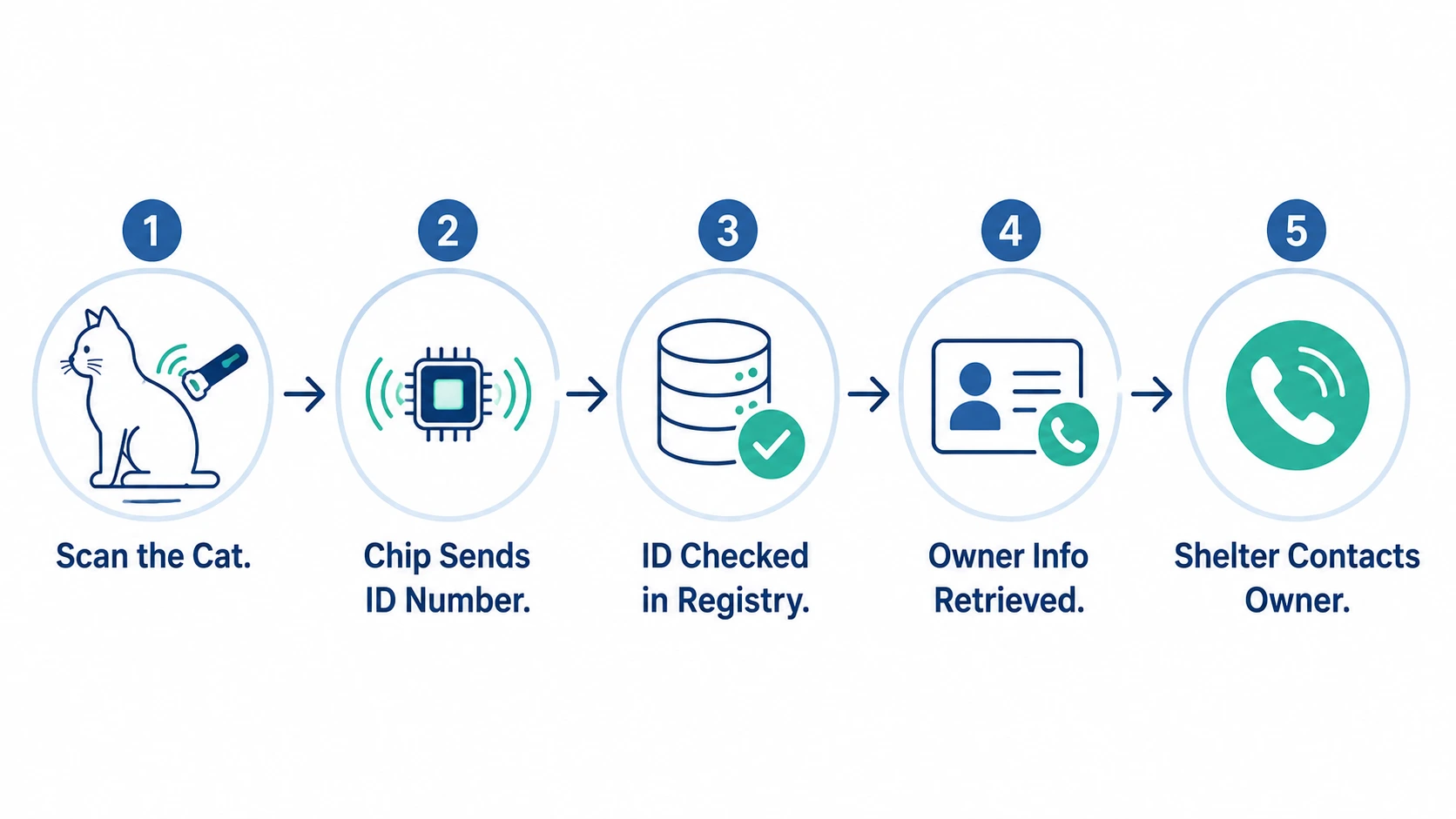 The process follows a consistent sequence at nearly every shelter and veterinary clinic:
- A universal scanner is passed over the cat’s body, most commonly near the shoulder blades.
- The scanner reads the chip’s unique ID number.
- Staff enter that number into a national or regional pet recovery registry.
- If the registration is current, the registry returns the owner’s contact information.
- The facility contacts the owner directly.
This system only works end-to-end if the chip is registered and the contact details are accurate, which is why registry updates are considered a core part of responsible microchipping.
What Is a Microchip for Cats?
“This type of chip uses passive radio-frequency identification (RFID) technology, meaning it has no battery and only activates when read by a compatible scanner.”
A cat microchip is a passive radio-frequency identification (RFID) device, roughly the size of a grain of rice, implanted just beneath the skin. It contains no battery and no power source of its own; it remains inert until activated by a scanner’s radio signal, at which point it transmits its stored ID number.
Because it has no moving parts, no battery to replace, and no internal electronics beyond the chip itself, it is designed to function for the lifetime of the animal without maintenance.
Benefits of Microchipping Cats
Veterinary and animal welfare organizations consistently cite several concrete benefits of microchipping:
- Permanent identification that cannot fall off, fade, or be removed the way a collar tag can.
- Higher odds of reunification if a cat escapes, including indoor-only cats that get out unexpectedly.
- Proof of ownership in the event of a dispute over a found or rehomed cat.
- Travel documentation support, as many countries and airlines require microchip verification for cats crossing international borders.
Because collars can slip off and tags can become illegible, a microchip functions as a backup identification method that remains intact even when external ID is lost.
Should You Microchip Your Cat?
Indoor cats face other hidden risks too — for example, hairballs are a common but manageable issue that many owners mistake for something more serious.”
Veterinarians generally recommend microchipping for all cats, regardless of whether they go outdoors. Indoor cats can still escape through open doors, windows, or during emergencies such as fires or natural disasters, situations in which a collar is often lost or removed.
Is It Worth It for Indoor-Only Cats?
Yes. A large share of cats reported lost to shelters are indoor cats that escaped unexpectedly. Since these cats are often unfamiliar with navigating outdoors, they are more likely to end up at a shelter or clinic than to find their way home — making a scannable ID especially valuable.
This is especially relevant for indoor cats, since even cats prone to eye infections or other sudden health issues are more likely to bolt through an open door during a stressful vet visit.
What Vets Recommend
Current veterinary guidance treats microchipping as a standard part of preventive care, often performed during a routine wellness visit or at the time of spay or neuter. Many veterinarians recommend it as a one-time procedure with lasting benefit, rather than an optional add-on.
“Preventive steps like microchipping fit into a broader wellness routine, alongside care topics covered in our cat care guide.”
Where Are Microchips Placed in Cats?
“This placement is chosen for consistency during routine exams, much like vets check other fixed areas during annual visits, such as reviewing healthy cat teeth vs. unhealthy signs.”
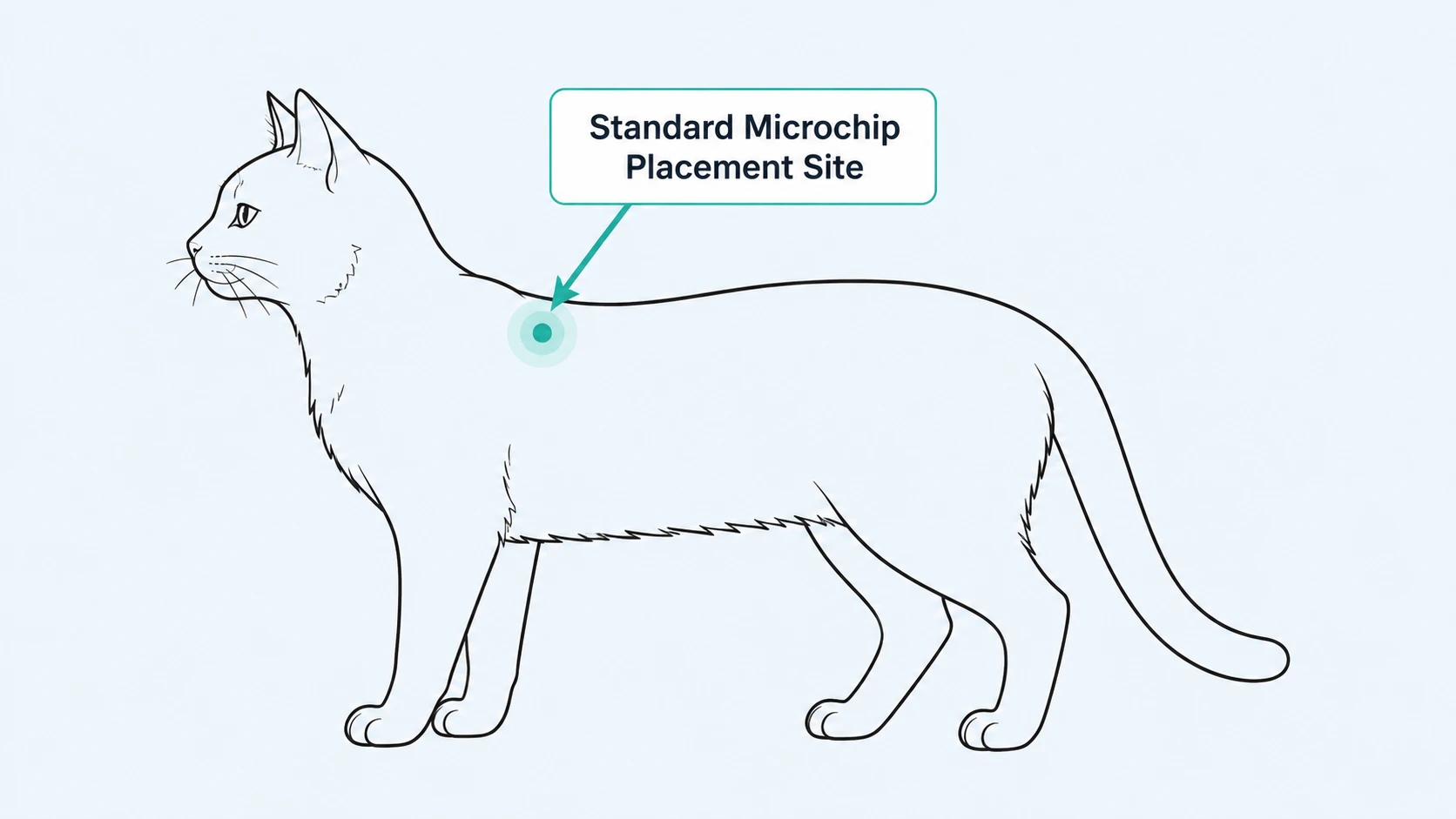
The standard placement site for a cat microchip is subcutaneously (under the skin) between the shoulder blades, along the dorsal midline. This location is chosen because it is easy to access, has minimal muscle movement, and is a consistent site that scanners are trained to check first.
In rare cases, chips can migrate slightly from the original implantation site to a nearby area, which is why veterinarians scan a broader region rather than only the exact injection point.
How to Microchip a Cat
Microchipping is a brief, minimally invasive procedure typically performed by a licensed veterinarian or trained shelter staff. The standard steps are:
- The chip is scanned before implantation to confirm it reads correctly.
- The chip is loaded into a sterile, single-use syringe-like applicator.
- It is injected under the skin between the shoulder blades.
- The area is scanned again immediately after to confirm proper function and placement.
Most cats do not require sedation. Some owners choose to have the chip implanted while the cat is already under anesthesia for a spay or neuter procedure, purely for convenience rather than medical necessity.
Can You Microchip a Cat Yourself?
Professional implantation is strongly recommended over at-home kits. Veterinary clinics use sterile, single-use applicators and immediately verify chip placement and function with a scanner — a step that is difficult to replicate safely at home. Improper injection technique also increases the risk of incorrect placement or infection.
Are Microchips Safe for Cats?
“If you notice ongoing redness, discharge, or swelling anywhere on your cat beyond the injection site — for example, if your cat’s eye looks red or irritated — it’s worth a separate veterinary check, since this is unrelated to normal microchip healing.”
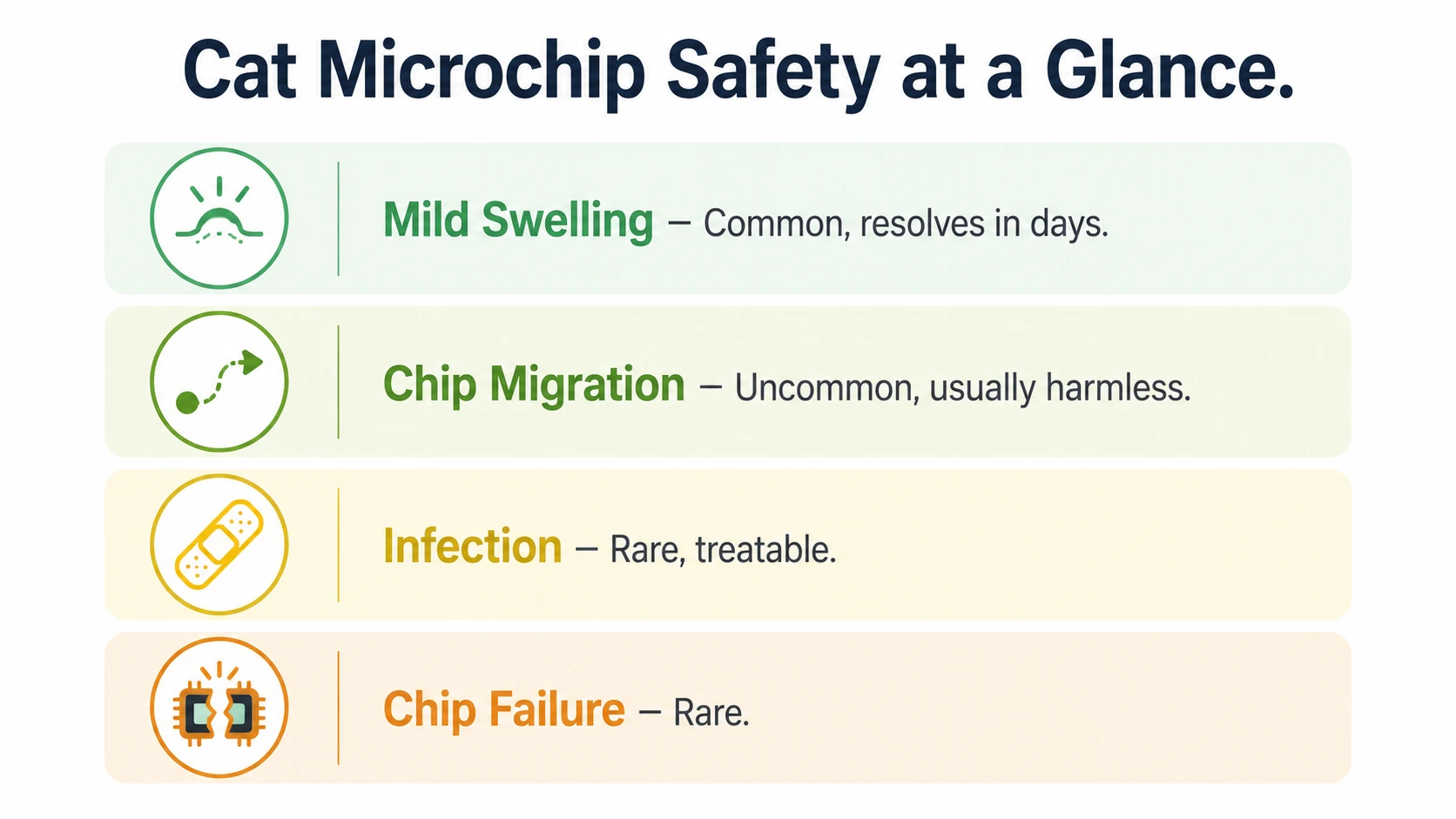
Yes, microchipping is widely regarded by veterinarians as a safe procedure, with serious complications considered rare. The most common reaction is mild, temporary swelling or soreness at the injection site, which typically resolves within a few days without treatment.
Other reported but uncommon complications include:
| Complication | Frequency | Typical Outcome |
| Mild swelling or soreness at injection site | Common | Resolves within a few days |
| Chip migration | Uncommon | Usually harmless; chip is still detectable via broader scanning |
| Infection at injection site | Rare | Treatable; requires veterinary attention if it occurs |
| Chip failure or malfunction | Rare | Chip may need replacement |
A frequently raised concern is whether microchips are linked to cancer. Some anecdotal reports have described tumors forming near microchip implantation sites in cats, but larger scientific studies have not found an increased cancer risk associated with microchipping. Notably, the incidence of fibrosarcoma in cats has not risen alongside the growing use of microchips, unlike the pattern seen historically with certain vaccine-associated sarcomas. Most veterinarians consider the benefit of reliable identification to outweigh this small and unconfirmed risk.
Does Microchipping Hurt Cats?
“Mild, short-term discomfort after a procedure is normal, similar to what’s seen after routine care like a cat tooth extraction recovery, and should resolve within a few days.”
Microchipping causes brief, mild discomfort comparable to a routine vaccination injection, rather than significant pain. Cats typically resume normal activity immediately afterward.
How Long Does It Take a Microchip Site to Heal?
Any minor soreness or swelling at the injection site generally resolves within 24 to 48 hours. Owners should contact a veterinarian if swelling, redness, or discharge persists beyond a few days, as this could indicate infection.
Microchipping Cats: Pros and Cons
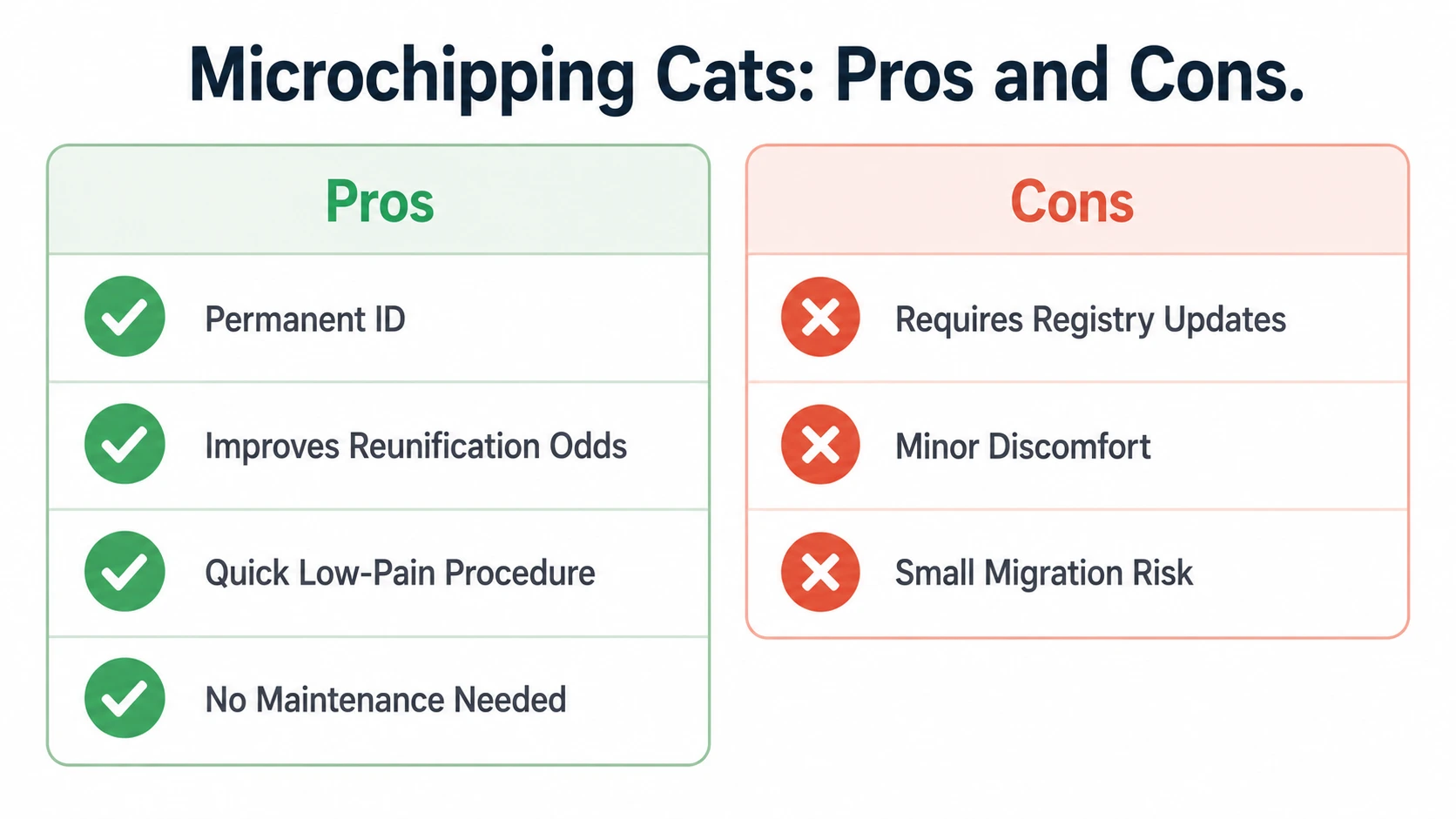
| Pros | Cons |
| Permanent, tamper-proof identification | Does not physically prevent a cat from getting lost |
| Improves odds of reunification | Requires registry information to stay updated |
| Quick, low-pain procedure | Small chance of migration or malfunction |
| No maintenance or battery required | Minor, temporary discomfort during implantation |
| Often required for international pet travel | Rare risk of infection at injection site |
Common Owner Mistakes with Cat Microchips
Just as owners often overlook subtle warning signs like crystals in cat urine, they frequently forget to update microchip registry details after a move.
A common mistake is assuming that implanting the chip is the only step required. In practice, several ongoing actions determine whether a microchip actually works when needed:
- Never registering the chip after adoption or purchase, leaving it functionally useless.
- Assuming the chip tracks location in real time, which standard pet microchips cannot do.
- Not confirming the chip still scans properly during annual wellness visits.
- Forgetting to update the registry after a move, phone number change, or change of ownership.
Furry Care Hub recommends treating microchip registration the same way as any other permanent record — reviewed and updated whenever contact information changes.
Conclusion
A microchip gives a cat permanent, scannable identification that dramatically improves the likelihood of reunification if the cat becomes lost, with only minor, well-documented risks involved. The procedure is quick, generally low-pain, and requires no ongoing maintenance beyond keeping registry information current. For most cats, indoor or outdoor, the benefits of microchipping clearly outweigh the small and rare risks involved.
“Microchipping is one part of a larger commitment to feline wellness — explore our senior cats care guide for more preventive health steps as your cat ages.”
FAQ
- What does a microchip do for a cat?
A microchip gives a cat a permanent, unique ID number that can be scanned by vets and shelters to identify the cat and contact its registered owner if it becomes lost
Cats that go missing are sometimes brought in showing unrelated symptoms, such as sneezing and vomiting from stress or exposure — another reason shelters rely on a scannable ID to quickly locate the right owner.”
- Does microchipping hurt cats?
Microchipping causes brief, mild discomfort similar to a vaccine injection. Most cats show no lasting signs of pain and return to normal activity immediately. - Are microchips safe for cats?
Yes. Serious complications are rare. The most common reaction is temporary swelling or soreness at the injection site, and current research has not confirmed an increased cancer risk from microchipping. - Where are microchips placed in cats?
Microchips are placed subcutaneously between a cat’s shoulder blades, a location chosen for ease of access and consistency during scanning. - Can a lost cat be found without a microchip?
Yes, but a collar or tag alone can be lost, removed, or become illegible, which lowers the chances of identification compared to a permanently implanted microchip. - Should I get my indoor cat microchipped?
Yes. Indoor cats can still escape through doors, windows, or during emergencies, and are often less able to find their way home than outdoor cats, making a microchip especially valuable.