

According to Furry Care Hub, osteoarthritis in dogs typically presents as stiffness after rest, reluctance to jump or climb stairs, limping, slower walks, muscle loss in the limbs, and difficulty rising. Dogs may also lick or chew affected joints, show behavioral changes like irritability, and exhibit visible joint swelling, especially in hips, knees, and elbows.
Symptoms often worsen after cold or damp weather and can fluctuate day to day, making early-stage arthritis easy to mistake for normal aging rather than a medical issue. Radiographic severity doesn’t always correlate with a dog’s actual pain level, so behavioral changes frequently signal the disease before imaging confirms it. A hallmark pattern — morning stiffness that eases within 15 to 20 minutes of gentle movement — helps distinguish osteoarthritis from acute injury. Osteoarthritis is one of the most common conditions we cover as part of our broader look at dog health problems, since it affects a large share of adult and senior dogs.
Quick Summary
- Osteoarthritis in dogs is a lifelong, progressive breakdown of joint cartilage — not a normal or harmless part of aging.
- Early warning signs include slowness to rise, reluctance to jump or climb stairs, and stiffness that eases as the dog “warms up.”
- OA cannot be cured, but it can be managed for years with weight control, exercise modification, and veterinary-guided pain relief.
- Persistent limping, sudden reluctance to move, or visible pain behaviors are reasons to schedule a veterinary evaluation, not to “wait and see.”
What Is Osteoarthritis in Dogs?
Osteoarthritis in dogs is a chronic, progressive disease of the synovial joints in which cartilage degenerates, joint fluid changes, and the joint capsule becomes inflamed, leading to pain and loss of normal movement. It is the most common form of arthritis diagnosed in dogs and one of the leading causes of chronic pain in the species. Because OA becomes more common with age, it’s a key part of what to watch for in our broader senior profile for dogs, alongside other age-related health changes.
Veterinarians sometimes use “arthritis” as an umbrella term covering any joint inflammation, while osteoarthritis and degenerative joint disease (DJD) refer specifically to this cartilage-driven, wear-based process rather than infectious or immune-mediated forms of joint disease. In practice, vets use OA and DJD interchangeably. Osteoarthritis develops within the synovial joints — the fluid-filled, cartilage-lined joints that allow smooth, low-friction movement — as their protective cartilage breaks down faster than the body can repair it.
OA most commonly affects the:
- Hips — often linked to hip dysplasia
- Elbows — often linked to elbow dysplasia
- Knees (stifles) — often linked to cranial cruciate ligament injury
- Spine — causing back or neck stiffness
Unlike in humans, where OA is usually tied to age-related wear, canine OA frequently has an identifiable underlying cause, such as a developmental joint disorder or ligament injury, which means it can appear in surprisingly young dogs.
Early Signs vs. Advanced Signs of Osteoarthritis
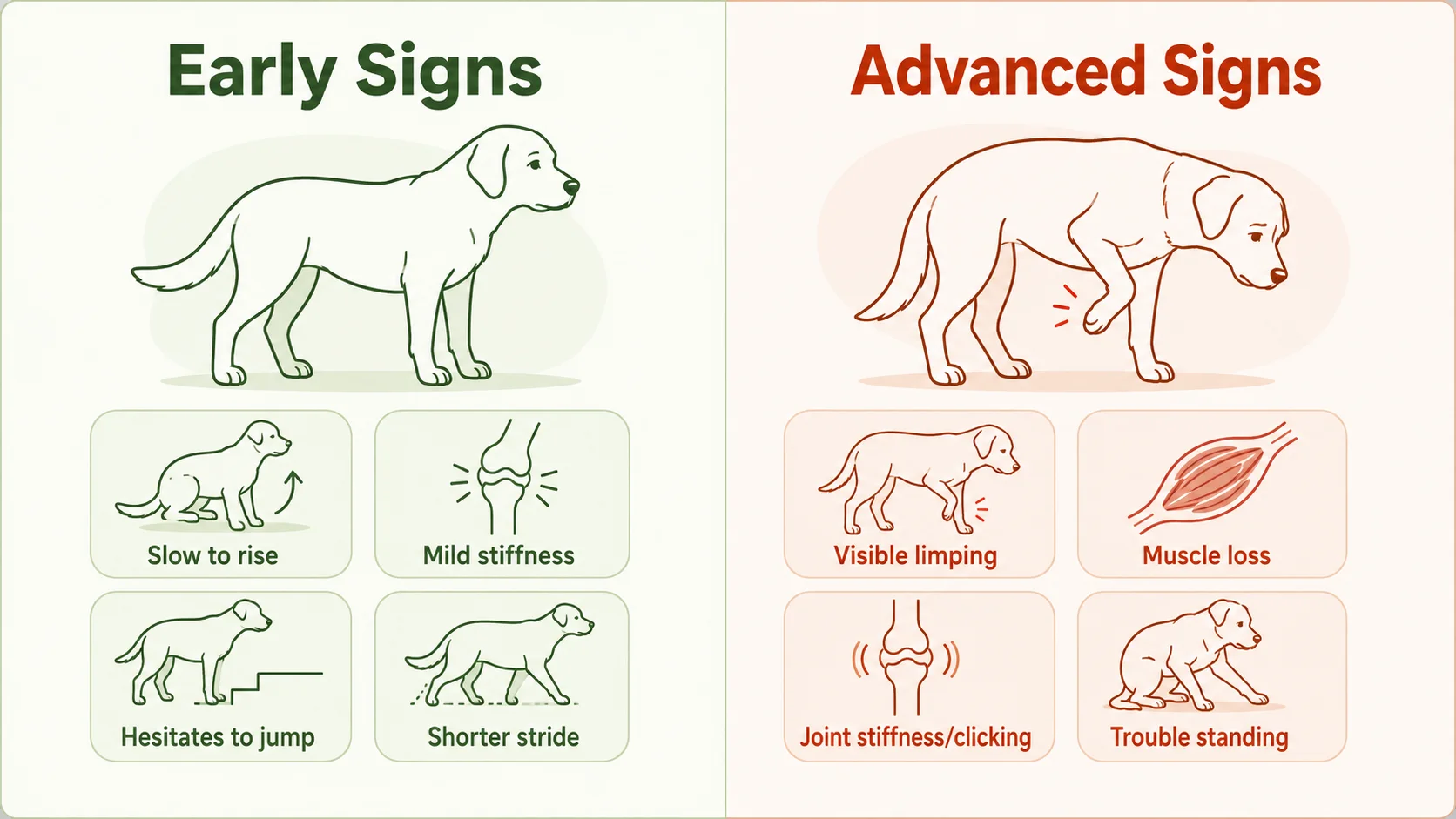
Osteoarthritis symptoms in dogs typically fall into two clusters: subtle early signs that are easy to mistake for normal aging, and more obvious advanced signs that appear once significant joint damage has occurred. Recognizing the early cluster is what allows management to start before the dog is in constant pain.
Early-Stage Symptoms
- Slower to rise from lying down or sitting
- Stiffness that improves after a few minutes of moving
- Mild hesitation before jumping onto furniture or into the car
- Slight lag when walking or a shorter stride length
- Reduced enthusiasm for walks or play the dog previously enjoyed
Advanced / Chronic Symptoms
- Persistent, visible limping or favoring a limb
- Noticeable muscle loss (atrophy) around an affected joint
- Difficulty standing without assistance
- Audible or palpable joint crepitus (grinding/clicking)
- Personality changes such as withdrawal or irritability
| Symptom | Stage Typically Seen | What It Indicates |
| Slow to rise, mild stiffness | Early | Cartilage changes beginning; joint still functional |
| Reluctance to jump or use stairs | Early to moderate | Discomfort with joint loading |
| Visible limping, shorter stride | Moderate | Established joint pathology |
| Muscle atrophy, reduced range of motion | Moderate to advanced | Chronic disuse and ongoing pain |
| Difficulty standing, constant pain signs | Advanced | Significant, likely irreversible joint damage |
Symptoms by Affected Leg or Area
Where a dog shows symptoms of osteoarthritis often depends on which joints are affected, and front-leg OA can look quite different from hind-leg or spinal OA. Because many dogs develop OA in both limbs on one end of the body, a classic one-sided limp is not always present.
Symptoms in the Back Legs / Hind Legs
Hind-limb osteoarthritis is commonly linked to hip or knee joints and often shows up as:
- Difficulty rising from a lying position, especially on hard floors
- A “bunny hopping” gait, where both back legs move together
- Sitting off to one side rather than squarely
- Weakness or wobbliness in the rear end
- Reluctance to climb stairs or jump into vehicles
Symptoms in the Front Legs
Front-limb osteoarthritis, often centered in the elbows or shoulders, tends to present as:
- Head-bobbing while walking (the head lifts as weight shifts off the sore leg)
- Shortened stride in the front limbs
- Reluctance to bear weight after rest, easing with gentle movement
- Sensitivity when the front legs or shoulders are touched
Dogs with spinal OA may show general stiffness through the back, a hunched posture, or reluctance to be touched along the spine, rather than symptoms isolated to one limb.
How Dogs Show Pain (Behavioral Signs)
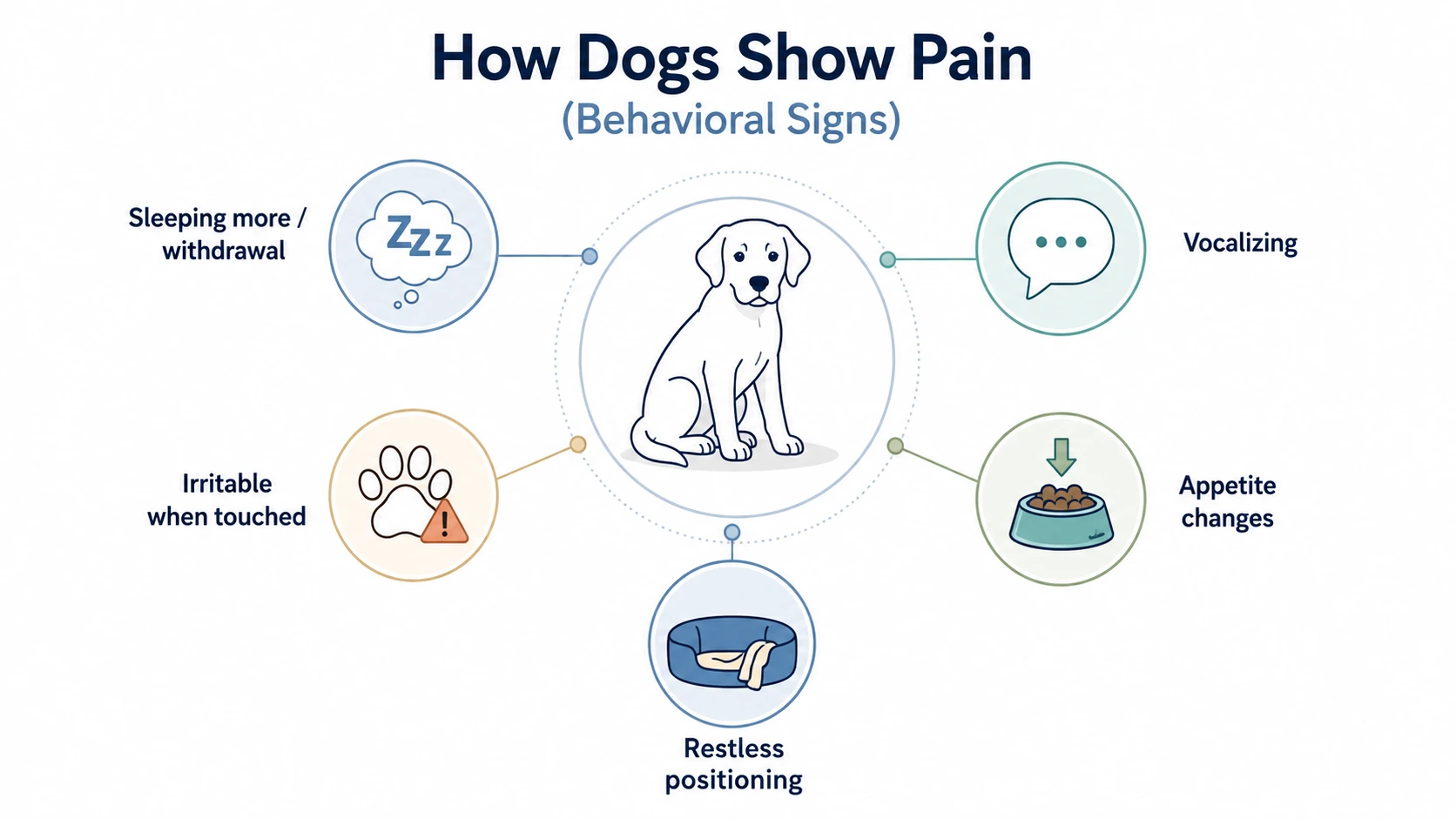
Dogs show arthritis pain primarily through behavior rather than obvious physical symptoms, because they instinctively mask overt signs of weakness. Owners are more likely to notice changes in posture, activity, and temperament before they notice a true limp.
Common behavioral pain signals include:
- Changes in resting posture — lying with a leg held stiffly, or shifting positions frequently while trying to get comfortable
- Vocalizing — occasional yelping or whimpering when moving, being touched, or changing position
- Withdrawal — choosing to rest alone rather than following the family around
- Irritability or guarding — snapping, growling, or flinching when a sore joint is touched, even in dogs that are normally easygoing
- Appetite or sleep changes — eating less or sleeping more due to chronic discomfort
Many pet owners notice these behavioral shifts weeks or months before a physical symptom like limping becomes obvious, which is exactly why chronic pain in dogs is frequently under-recognized until it has progressed significantly.
What Causes and Worsens Canine Osteoarthritis
Canine osteoarthritis is caused by a combination of joint-level damage and whole-body risk factors, rather than a single trigger. In dogs, OA most often develops secondary to an underlying joint problem rather than from age-related wear alone. Even an injury that heals fully can leave lasting joint damage — for example, a hip fracture in dogs frequently leads to secondary osteoarthritis in that joint years later.
Primary contributing causes:
- Developmental joint disorders — hip dysplasia and elbow dysplasia are leading underlying causes of canine OA
- Cranial cruciate ligament injury — one of the most common causes of knee (stifle) OA
- Joint trauma — fractures, dislocations, or previous injuries involving a joint surface
- Breed predisposition — larger breeds and certain breeds are statistically more prone to developmental joint disease
- Age — cartilage becomes less able to repair itself over time
Factors that worsen or accelerate progression:
- Obesity — excess body weight increases mechanical load on joints and drives inflammation
- Overexertion — high-impact activity on an already compromised joint
- Cold weather — many owners and vets report stiffer, more painful joints in cold conditions
- Hard or slippery flooring — increases joint strain and injury risk in dogs with reduced stability
- Inactivity — while overexertion is harmful, prolonged inactivity leads to muscle loss that further destabilizes the joint
Because even a few extra pounds measurably increases joint load, it’s worth checking how to tell if your dog is overweight before assuming stiffness is age-related rather than weight-related.
Stages of Osteoarthritis in Dogs
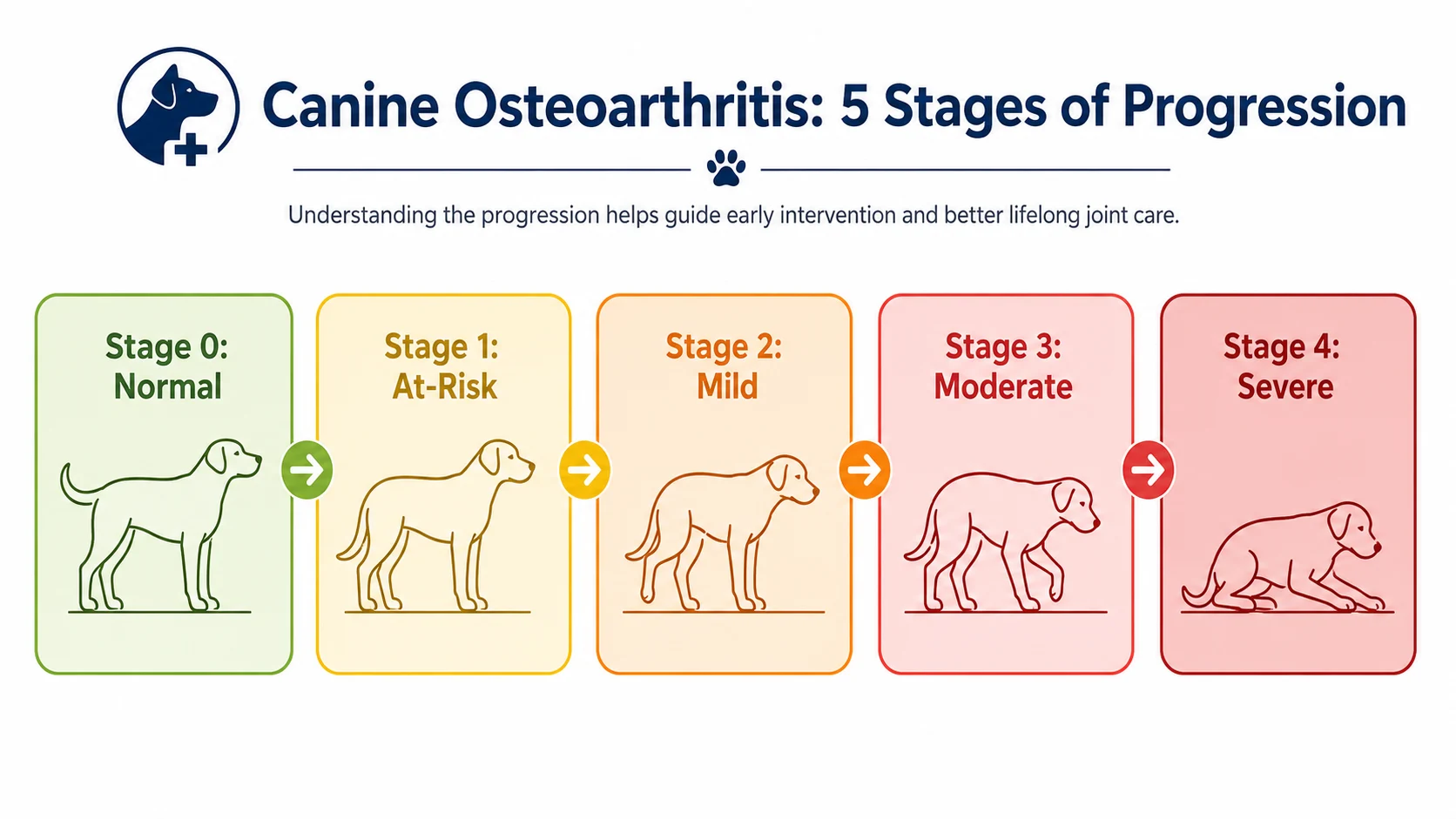
Veterinarians increasingly stage canine osteoarthritis using a structured 0–4 framework similar to the Canine Osteoarthritis Staging Tool (COAST), which combines owner-reported signs, physical exam findings, and imaging to classify severity. Understanding the stage helps set realistic expectations for treatment.
| Stage | Description | Typical Signs |
| 0 | Clinically normal, no risk factors | None |
| 1 | Clinically normal, but risk factors present (breed, prior injury, weight, age) | None yet visible to the owner |
| 2 | Mild osteoarthritis | Subtle stiffness, slower to rise, mild activity changes |
| 3 | Moderate osteoarthritis | Visible limping, reluctance on stairs/jumping, muscle changes beginning |
| 4 | Severe osteoarthritis | Constant lameness, significant muscle loss, marked mobility limitation |
Early-stage dogs (0–2) often show few or no signs an owner would catch without a veterinary exam, which is a key reason vets recommend baseline joint checks in at-risk breeds well before old age.
How Vets Diagnose Osteoarthritis
Veterinarians diagnose osteoarthritis in dogs through a combination of a hands-on physical and orthopedic exam, a gait assessment, and X-rays, along with ruling out other conditions that can mimic OA. No single test confirms OA on its own — diagnosis is built from several pieces of evidence together.
A typical diagnostic workup includes:
- History and owner-reported changes — activity level, stiffness patterns, and behavior shifts at home
- Physical and orthopedic exam — palpating joints for pain, swelling, or crepitus, and assessing range of motion
- Gait analysis — observing how the dog walks, trots, sits, and rises
- Radiographs (X-rays) — checking for osteophytes (new bone growth), joint space narrowing, and changes in bone shape
- Ruling out other causes — differentiating OA from hip dysplasia, cruciate ligament injury, or, less commonly, joint infection or cancer
In ambiguous cases, a veterinarian may refer radiographs to a specialist or recommend advanced imaging to confirm the diagnosis.
How Osteoarthritis Is Managed
Osteoarthritis in dogs is managed through a multi-modal approach that combines weight control, activity modification, home adjustments, and veterinary-guided pain management, rather than any single treatment. Because OA cannot be cured, the goal of management is to slow progression and control pain. In dogs with advanced hip OA that no longer responds to conservative management, a veterinarian may discuss surgical options — our guide to FHO surgery for dogs explains what that procedure involves and its recovery process.
Common management categories include:
- Veterinary-prescribed pain control — NSAIDs and other medications used under veterinary supervision to manage inflammation and pain
- Weight management — maintaining a lean body condition is one of the most effective ways to reduce joint stress
- Physical therapy and rehabilitation — guided exercises, hydrotherapy, and controlled movement to preserve muscle and joint function
- Joint supplements (as a category) — nutraceuticals are sometimes used alongside other treatments, though evidence varies by product; a veterinarian can advise on suitability
- Low-impact exercise — consistent, gentle activity such as short leash walks or swimming, avoiding high-impact play
- Home modifications — ramps or steps to avoid jumping, orthopedic bedding, and non-slip flooring or rugs on hard surfaces
Furry Care Hub recommends discussing any new supplement, medication, or exercise change with a veterinarian first, since the right combination depends on the dog’s stage of OA, affected joints, and overall health.
Common Owner Mistakes and Misconceptions
The most common mistake owners make with canine osteoarthritis is dismissing early signs as normal aging and waiting until symptoms are severe before seeking veterinary care. By the time limping is obvious, significant joint damage has often already occurred.
Other frequent mistakes include:
- Over-restricting exercise entirely — complete inactivity accelerates muscle loss and can worsen joint instability; the goal is modified activity, not none
- Skipping weight management — even modest weight loss can meaningfully reduce joint load and pain
- Assuming “it’s just old age” — OA is a diagnosable, manageable disease, not an inevitable and untreatable part of getting older
- Delaying a vet visit until the dog is limping — behavioral changes usually appear first and are worth investigating sooner
A common misconception worth addressing directly: is it cruel to keep a dog with arthritis? No — a diagnosis of osteoarthritis is not, by itself, a reason to consider euthanasia. Most dogs with OA respond well to management and maintain a good quality of life for years. Quality-of-life concerns become relevant only in advanced, poorly controlled cases where pain and mobility loss are severe and unresponsive to treatment — a decision that should always be made with a veterinarian’s guidance, not based on the diagnosis alone.
Osteoarthritis vs. Other Joint Conditions
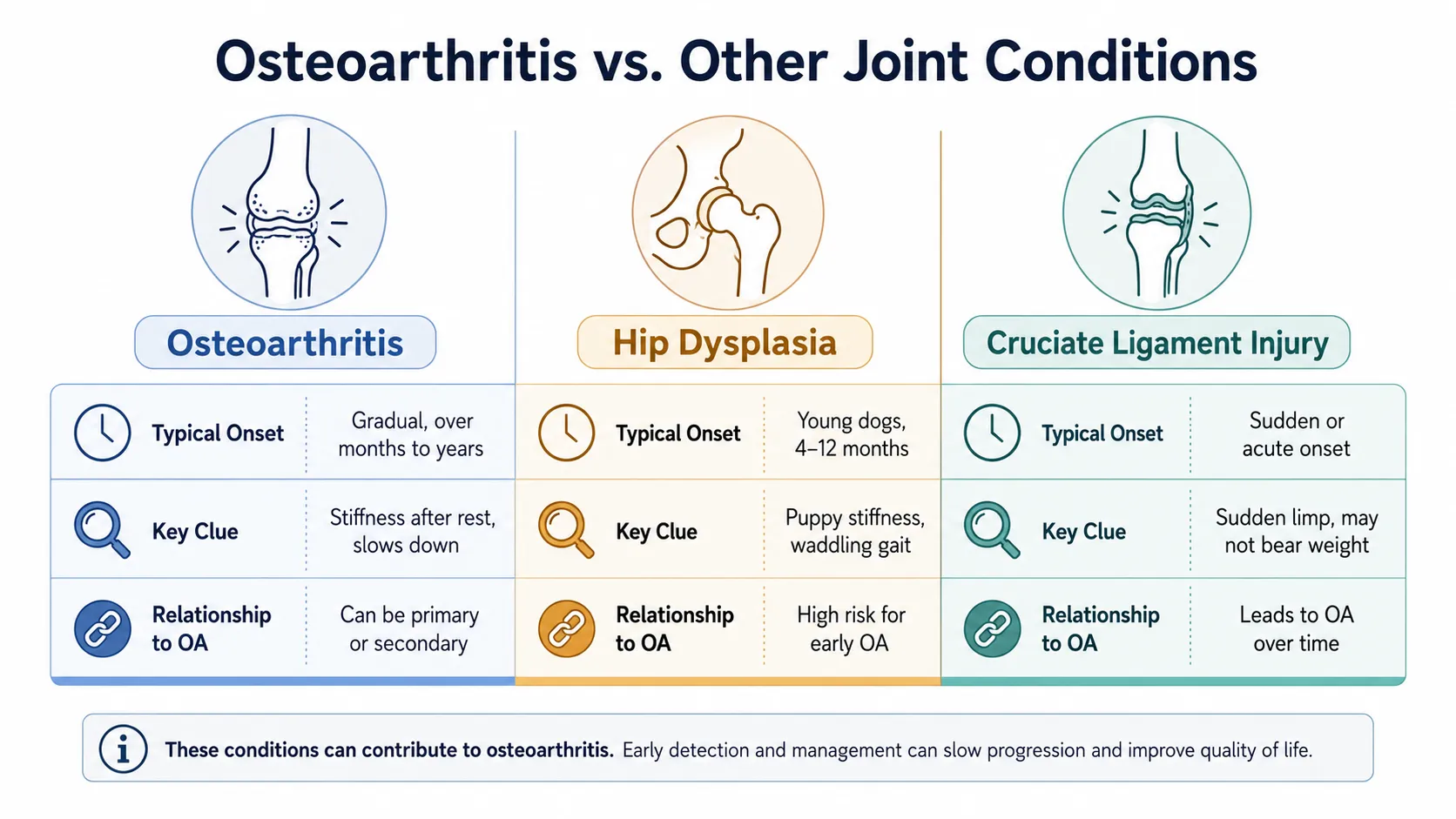
Osteoarthritis often overlaps with or results from other joint conditions, particularly hip dysplasia and cranial cruciate ligament (CCL) injury, which can make the underlying cause difficult to pinpoint without veterinary evaluation. In fact, both conditions frequently coexist in the same dog.
| Feature | Osteoarthritis (OA) | Hip Dysplasia | Cranial Cruciate Ligament (CCL) Injury |
| What it is | Secondary, progressive cartilage breakdown in any joint | A developmental hip joint malformation that leads to OA over time | A torn or degenerated knee ligament that leads to OA over time |
| Typical onset | Any age; often secondary to another condition | Often first seen in dogs 5–12 months old, or later as chronic OA | Sudden (acute tear) or gradual (degenerative tear); common in adult dogs |
| Onset pattern | Gradual | Can be gradual (chronic) or appear early in growth | Can be sudden (non-weight-bearing) or gradual |
| Key clue | Stiffness, gradual mobility decline in one or more joints | “Bunny hopping” gait, hind-end laxity | Sudden severe lameness, or a dog that sits asymmetrically |
| Relationship to OA | OA is the end result | A leading underlying cause of hip OA | A leading underlying cause of knee OA |
Because these conditions overlap so heavily, a dog referred for suspected hip dysplasia may, on closer exam, actually have a cruciate ligament injury (or both) — which is why a full orthopedic workup matters more than symptom-matching alone. Two other conditions are commonly mistaken for early OA and are worth ruling out on their own: a signs of luxating patella in dogs can cause a similar skip-and-limp gait in the hind legs, particularly in small breeds
Life Expectancy and Long-Term Outlook
Osteoarthritis in dogs does not typically shorten lifespan on its own, but poorly managed pain and mobility loss can lead to secondary problems, such as further muscle loss, weight gain, and reduced overall health, that affect long-term quality of life. Most dogs with well-managed OA live out a normal expected lifespan for their breed and size.
It’s worth separating two distinct ideas:
- Does OA directly cause death? No. Dogs are not generally reported to die directly from osteoarthritis itself.
- Can unmanaged OA shorten a comfortable life? Yes, indirectly. Chronic pain and inactivity can contribute to muscle wasting, weight gain, and a decline in general health that affects both longevity and daily comfort.
End-stage or advanced OA can significantly reduce quality of life, with dogs struggling to rise, walk, or stay comfortable even at rest. In these cases, decisions about long-term care — including whether to pursue more intensive treatment or consider euthanasia — should be guided by a veterinarian’s assessment of pain control and mobility, not by the stage label alone. In our experience caring for dogs through every stage of OA, consistent, early management is what most reliably preserves both comfort and time. If back stiffness is paired with wobbliness, dragging paws, or sudden pain when touched along the spine, it’s worth reviewing how to treat IVDD in dogs at home, since intervertebral disc disease can closely mimic spinal osteoarthritis.
When to See a Vet
A dog showing any early signs of osteoarthritis — stiffness, slowness to rise, or reduced interest in activity — should see a veterinarian rather than “waiting to see if it gets worse,” since earlier intervention slows progression more effectively than late intervention. If your dog is showing acute pain and you’re waiting on an appointment or an emergency slot, our guide on how to comfort a dog in pain waiting for the vet covers safe, practical steps you can take at home in the meantime.
Schedule a prompt or urgent veterinary visit if a dog shows:
- Sudden, non-weight-bearing lameness
- Crying out in pain when moving or being touched
- Complete inability to rise or stand
- Rapid worsening of symptoms over days rather than months
Schedule a routine veterinary evaluation if a dog shows:
- Gradual stiffness or slowness to rise
- Mild reluctance to jump, use stairs, or play as before
- Subtle behavior changes such as increased irritability or withdrawal
Early veterinary involvement allows for staging, a tailored management plan, and — critically — the chance to slow disease progression before significant joint damage sets in.
Conclusion
Osteoarthritis in dogs is a common, progressive, and currently incurable joint condition, but it is highly manageable when caught early. Recognizing the earliest signs — slower rising, mild stiffness, subtle behavior changes — and pairing that awareness with weight control, appropriate exercise, and veterinary-guided treatment gives most dogs years of comfortable, active life after diagnosis. The core takeaway for canine osteoarthritis is simple: early recognition and consistent management, not the diagnosis itself, are what determine a dog’s long-term quality of life.
FAQs
What are the earliest signs of osteoarthritis in dogs?
The earliest signs are usually subtle: slowness to rise from lying down, mild stiffness that improves after a few minutes of movement, and hesitation before jumping or using stairs. These signs are easy to mistake for normal aging.
How can I tell if my dog’s limping is arthritis or an injury?
Arthritis-related limping typically develops gradually and improves somewhat with gentle movement, while an acute injury usually causes sudden, more severe lameness. A veterinary exam and X-rays are needed to confirm the cause either way.
Do dogs with osteoarthritis live shorter lives?
Osteoarthritis does not typically shorten a dog’s life directly. However, poorly managed pain and reduced mobility can contribute to secondary issues like muscle loss and weight gain, which can affect long-term health if left unaddressed.
How do dogs act when they’re in pain from arthritis?
Dogs in pain from arthritis often show behavioral changes before physical ones: resting more, withdrawing from family interaction, becoming irritable when touched near a sore joint, or occasionally vocalizing during movement.
Can osteoarthritis in dogs get worse quickly?
Osteoarthritis usually progresses gradually over months to years, but a rapid worsening of symptoms can signal a new injury, a flare-up, or a separate joint problem, and warrants a prompt veterinary visit.
Is it possible to slow the progression of canine osteoarthritis?
Yes. While OA cannot be reversed, consistent weight management, appropriate low-impact exercise, and veterinary-guided pain control have all been shown to slow symptom progression and preserve joint function for longer.